Grain-Free Food and Cavalier King Charles Spaniels: What the FDA DCM Investigation Found
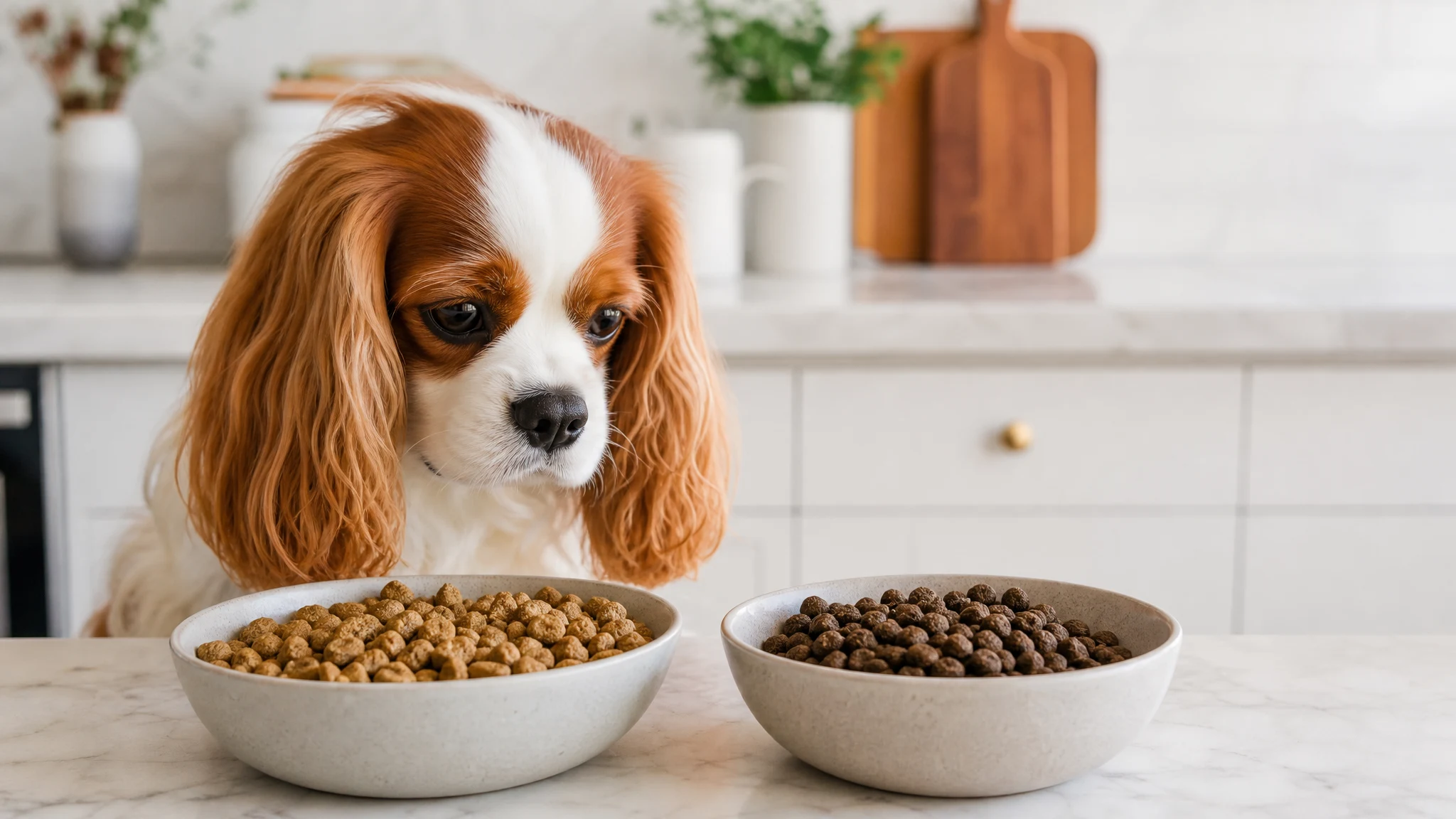
General nutrition information compiled from product labels and published sources, not veterinary advice. Your veterinarian is the right person to choose a diet for your dog, especially one with a health condition.
Few topics worry dog owners more than the link between grain free dog food and a serious heart condition. If you share your home with a Cavalier King Charles Spaniel, the worry can feel sharper, because this breed already has a well-known heart issue of its own.
This guide shows you how to read the FDA's canine dilated cardiomyopathy (DCM) investigation, check your dog's food label, and prepare for a useful talk with your veterinarian. It stays neutral. It does not tell you to switch foods, and it does not tell you to stay put.
What You Need Before You Start
- Your dog's current food bag or can, so you can read the label in full.
- A photo or note of the ingredient list, the guaranteed analysis and the nutritional adequacy (AAFCO) statement.
- Your dog's current weight and body condition from your most recent vet visit.
- A list of any heart findings, such as a murmur, that your veterinarian has already mentioned.
- About 20 minutes to read the FDA page linked in the Sources list below.
Step 1: Understand What the FDA Investigation Is
The FDA's Center for Veterinary Medicine (CVM) opened an investigation into a possible link between certain diets and canine dilated cardiomyopathy. DCM is a disease of the heart muscle. The FDA page is the primary source for this topic, and it is worth reading directly rather than relying on headlines.
The investigation looked at reports submitted to the agency. Reports are not the same as controlled studies. They show that cases were reported, but on their own they do not show what caused each case.
Step 2: Learn the Numbers and Their Dates
The FDA page gives figures for reports received from January 1, 2014 through April 30, 2019. In that period the agency reported 524 reports of DCM, 515 of them in dogs. Those reports involved 560 affected dogs and 119 dog deaths.
Two cautions help here:
- These numbers cover a fixed window of time. They are not a current count of cases.
- They are not a rate. The FDA page does not tell you how many dogs ate any given diet and stayed healthy.
Step 3: Check the Latest Status
The most recent update on the FDA page is dated December 23, 2022. The agency stated that it does not plan further public updates until there is meaningful new scientific information. We found nothing newer from the FDA on this investigation.
That means the question has not been formally closed, and it has not been answered with a clear cause either. Be wary of any pet food page, including a brand's own, that claims the matter is fully settled in either direction.
Step 4: Separate What Is Known From What Is Not
It helps to write the two lists down side by side.
| Reported by the FDA | Not established by that page |
|---|---|
| Hundreds of DCM reports were submitted between 2014 and April 2019. | That any one food type, including grain free dog food, causes DCM in a particular dog. |
| The agency investigated a possible link between certain diets and DCM. | That switching foods will change an individual dog's heart health. |
| The last public update was December 23, 2022. | A final answer. The FDA said it will update again only with meaningful new science. |
So when someone asks whether grain free dog food and DCM are connected, the careful answer is that the FDA investigated a possible link and has not published a conclusion beyond what its page states. Read the page itself for its exact wording.
Step 5: Ask Where Your Cavalier Fits
This is the part owners often get wrong. Cavaliers are famous for a heart condition, but it is a different one.
WebMD describes mitral valve disease (MVD) as the most common health condition in the breed. CavalierHealth.org, a breed-health advocacy site, says Cavaliers are over twenty times more likely to develop MVD than other breeds. Both are secondary sources, and the figure is a claim from an advocacy site, so treat it as a pointer rather than a fixed number.
The sources we reviewed for this breed do not state a DCM predisposition. We did not find one, and we will not guess. If you want to know whether the Cavalier King Charles Spaniel Club or a veterinary cardiologist sees a DCM concern in the breed, ask them directly.
Do not mix up the two conditions. MVD involves the heart valve. DCM involves the heart muscle. A murmur in your Cavalier is more likely to be discussed as MVD, and your veterinarian is the person who can tell you what applies to your dog.
Step 6: Read Your Dog's Food Label
Now compare what you learned with the bag. Look at these parts in order:
- The nutritional adequacy statement. It should say the food meets AAFCO nutrient profiles for your dog's life stage, either through formulation or feeding tests.
- The first five ingredients. These show what makes up most of the recipe by weight before cooking.
- The guaranteed analysis. Minimum protein and fat, and maximum fiber, are listed here.
- Calories per cup. This matters for weight, which comes up again below.
- Whether the label calls itself grain free. A "grain free" claim is a marketing term. It does not tell you how nutritious the food is.
For a sense of range, the label data we compared shows both kinds of foods on the market. Royal Canin's Cavalier King Charles Adult dry food is not grain free and lists brewers rice, wheat gluten, chicken by-product meal, corn and chicken fat first. Freshpet's Small Dog Bite Size Chicken Recipe is listed as grain free, with chicken, chicken liver, carrots, cranberries and eggs first. VICTOR's Hi-Pro Plus Small Breed Adult is not grain free and lists beef, chicken meal, beef meal, brown rice and whole grain millet first.
Please note how we got these. We compared label data published by each brand. We did not run feeding trials or taste tests, and this comparison says nothing about how any food performs in a real dog. Details can change, so confirm them on the brand's own page, such as the Freshpet product page.
For a wider look at labels aimed at this breed, see our guide to dog food options for Cavalier King Charles Spaniels.
Step 7: Check Weight and Portions
Weight is part of any heart-health talk with a vet. A secondary source, CavalierHealth.org, describes the breed as predisposed to obesity and cites a 1986 UK study. Treat that as a reason to watch your dog's body condition, not as a precise statistic.
An adult Cavalier is a toy-size dog. WebMD lists a typical adult weight of 13 to 18 pounds, and the Westminster Kennel Club lists a maximum of 18 pounds. Feeding guides on labels are starting points. Your veterinarian can help you adjust amounts as your dog's weight and activity change.
Calorie density varies a lot between foods. The label data we compared lists 339 kcal per cup for Royal Canin's Cavalier adult dry food, 360 kcal per cup for VICTOR's small breed adult, and 267 kcal per cup for Freshpet's small dog recipe. The same cup measure can give very different calories, so never swap foods cup for cup.
Step 8: Talk to Your Veterinarian
Bring your notes. A veterinarian knows your dog's heart findings, weight and history, which no article can. Useful questions include:
- Given my Cavalier's age and any heart findings, is my current food appropriate?
- Do you have concerns about the FDA's DCM investigation for my dog in particular?
- Is my dog at a healthy weight, and how many calories a day should I aim for?
- If I change foods, how should I make the switch?
If your dog has a diagnosed heart condition, any special diet is something your veterinarian decides and prescribes. Do not choose one yourself from a bag claim.
Tips for Doing This Well
- Go to the FDA page rather than a brand blog or social media post for the investigation's details.
- Take a photo of the label when you buy a new bag. Formulas can change, and the photo gives you something to compare.
- If you do change foods, transition gradually. Hill's, for example, suggests a seven-day transition on its small dog food page, and your vet can tailor the pace.
- Keep a short log of weight and appetite so you can notice changes early.
- For puppies, check the adequacy statement. Small-breed puppies can eat foods labeled for growth including large-size dogs, or all life stages foods that exclude large-dog growth. Your vet can confirm the right pick.
Common Mistakes to Avoid
- Treating "grain free" as either a warning or a benefit. The word describes an ingredient choice, not a health outcome.
- Confusing MVD with DCM. They are different heart conditions, and the breed's best-known one is MVD.
- Switching abruptly out of worry. Sudden changes can upset a dog's stomach, and a rushed switch is not a substitute for a vet's advice.
- Using old numbers as current ones. The 524 reports figure covers 2014 to April 2019.
- Skipping the calorie check. A new food with more calories per cup can quietly add weight.
- Adding supplements on your own. Leave that decision to your veterinarian.
What to Expect When You Finish
After these steps, you should have a clearer picture of what the FDA reported and what it has not concluded. You will also have your dog's label details written down and a short list of questions for your vet.
Your veterinarian may suggest keeping the current food, changing it, or running further checks, depending on your dog. No article can predict which, and no food choice can promise a particular health outcome. The FDA has not given a final answer, so the best plan is an ongoing conversation with your vet, especially as your Cavalier ages.
Is Grain Free Bad for Cavalier King Charles Spaniels?
The honest answer is that the available sources do not say so. The FDA investigated a possible link between certain diets and DCM and has not published a final conclusion. The breed sources we reviewed highlight MVD, not DCM, as the breed's main heart concern. Whether a grain free dog food suits your individual Cavalier is a question for your veterinarian.
Sources
- FDA Center for Veterinary Medicine: Investigation into a potential link between certain diets and canine dilated cardiomyopathy
- WebMD: What to know about Cavalier King Charles Spaniels
- CavalierHealth.org: Cavalier King Charles Spaniel overview
- CavalierHealth.org: Diets
- Westminster Kennel Club: Cavalier King Charles Spaniel breed page
- Royal Canin: Cavalier King Charles Adult
- VICTOR: Hi-Pro Plus Small Breed Adult
- Freshpet: Small Dog Bite Size Chicken Recipe
- Hill's Pet: Science Diet Adult Small & Mini Chicken & Brown Rice Recipe