How Much to Feed a Cavalier: Portion Guidelines by Life Stage
General nutrition information compiled from product labels and published sources, not veterinary advice. Your veterinarian is the right person to choose a diet for your dog, especially one with a health condition.
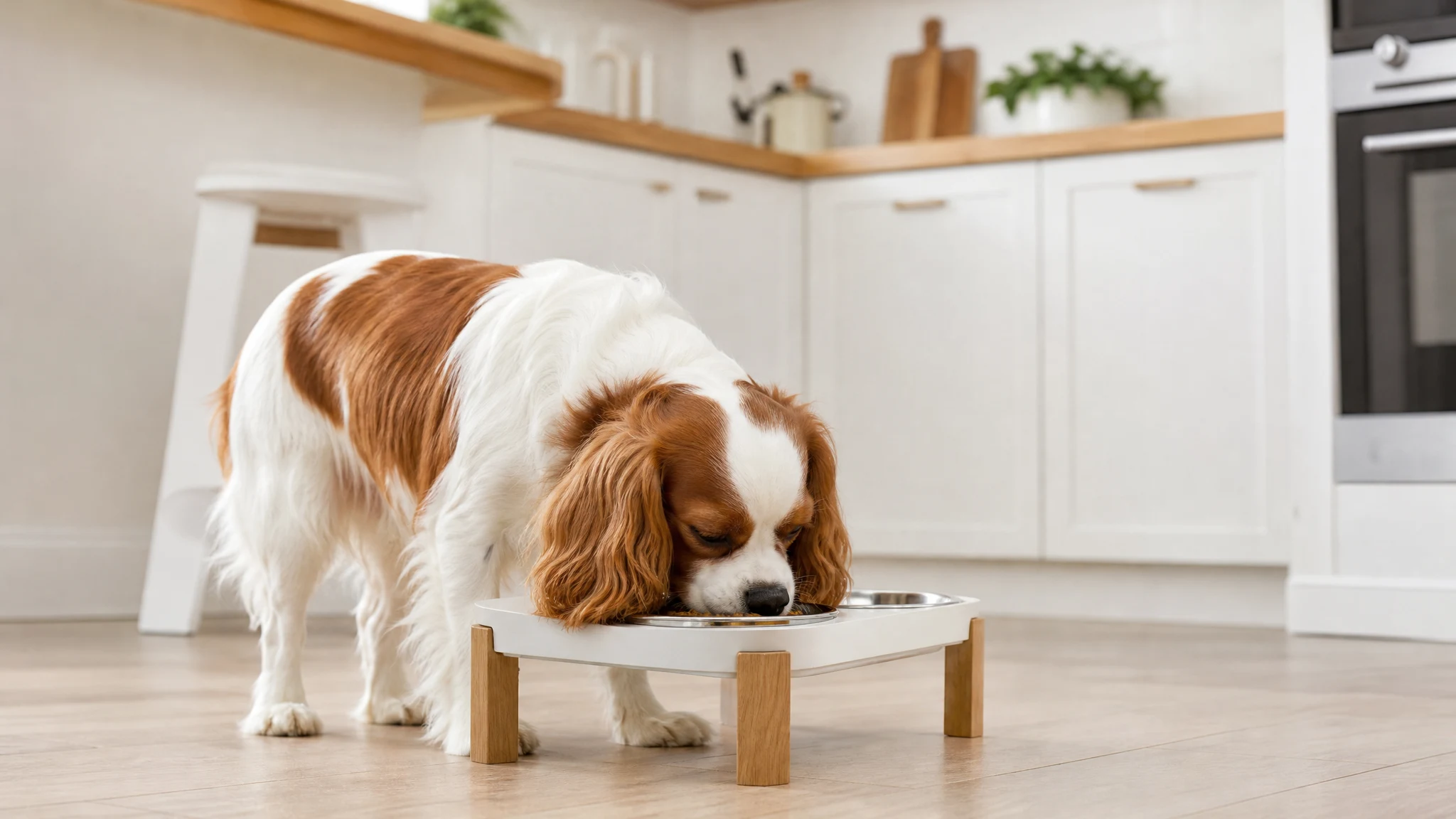
Working out the right cavalier feeding amount is mostly a matter of reading one chart, weighing your dog, and adjusting slowly. The chart on the bag is a starting point, not a verdict. Your dog's body condition tells you whether the number is right.
This guide walks through the steps for a Cavalier King Charles Spaniel at each life stage. It uses label data from a few brands, and we compared that label data only. We did not run feeding trials or taste tests.
For a deeper look at the topic, see our page on how much to feed a Cavalier King Charles Spaniel.
Why portions matter for this breed
The Westminster Kennel Club lists the Cavalier as a toy breed, with a maximum weight of 18 pounds. WebMD gives an adult range of 13 to 18 pounds and a height of 12 to 13 inches. That is a small body, so a few extra kibbles a day add up fast.
CavalierHealth.org, an advocacy site, describes the breed as predisposed to obesity and cites a 1986 UK study. Treat that as a secondary source, but it fits common sense: a small dog has little room for extra calories.
WebMD also names mitral valve disease, a heart condition, as the most common health condition in the breed. Diet and weight come up in vet conversations about it. We cannot say what any food does for a heart condition. If your Cavalier has a diagnosis, your veterinarian decides the feeding plan.
Materials you will need
- A standard dry measuring cup, or a kitchen scale that reads in grams or ounces
- A bathroom scale or a pet scale to track your dog's weight
- The bag, can or package of the food you chose, with its feeding chart and calorie statement
- A notebook or phone note for weights, portions and treats
- Your veterinarian's phone number for questions about your individual dog
Step 1: Confirm the food suits your dog's life stage
Start with the nutritional adequacy statement on the label. It tells you which life stage the food was made for.
Per the Whole Dog Journal's explanation of AAFCO wording, growth and all-life-stages foods must say either that they cover the growth of large dogs (70 pounds or more as an adult) or that they exclude it. A Cavalier will never reach 70 pounds, so a puppy can eat either type. The large-breed calcium concerns do not apply to this breed, per Vetstreet's growth notes.
Adult foods should say they meet AAFCO nutrient profiles for maintenance. Puppies need a growth or all-life-stages statement.
Step 2: Weigh your dog
Weigh your Cavalier before you pick a row on any chart. Hold your dog and step on a bathroom scale, then subtract your own weight. Or use a vet's scale at your next visit.
Charts are organized by weight, and for puppies, by age too. Using a guess instead of a real number is one of the most common errors.
Step 3: Find the starting amount on the label
Every brand sets out its chart differently. Here is what each product's own page shows, so you can see how much the formats vary.
| Food | Label calories | What the feeding chart shows |
|---|---|---|
| Royal Canin Cavalier King Charles Adult (dry) | 339 kcal per cup, calculated | Daily table for dogs 11 to 20 lb, split by low, medium or high activity |
| Royal Canin Cavalier King Charles Puppy (dry) | 368 kcal per cup, calculated | Daily table by age (2 to 9 months) and target adult weight of 11, 15 or 18 lb |
| Hill's Science Diet Adult Small & Mini Chicken & Brown Rice (dry) | 357 kcal per cup | From 1/4 cup a day for a 2 lb dog to 2 cups a day for a 25 lb dog |
| Hill's Science Diet Adult 11+ Small & Mini (dry) | 378 kcal per cup | Chart by dog weight; adjust to maintain optimal weight |
| Freshpet Small Dog Bite Size Chicken Recipe (fresh) | 267 kcal per cup, calculated | 11 to 15 lb: 1 to 1 1/4 cups. 16 to 20 lb: 1 1/4 to 1 2/3 cups |
| VICTOR Hi-Pro Plus Small Breed Adult (dry) | 360 kcal per cup | 5 lb: 0.5 cup. 10 lb: 1 cup. 15 lb: 1 1/2 cups |
Look at the calories per cup. A cup of one food is not a cup of another. Freshpet lists 267 kcal per cup, while the Hill's senior formula lists 378. Swapping foods and keeping the same scoop can change your dog's daily calories quite a bit.
For Royal Canin and Hill's, the exact cup figures sit in tables on the brand pages, so check the current chart there. We do not copy those tables here because brands can update them.
Step 4: Adjust for your dog's life stage
Puppies, about 8 weeks to 10 months
Royal Canin lists its Cavalier puppy formula for 8 weeks to 10 months, with a chart by age and expected adult weight. Pick the column closest to your puppy's expected size, then ask your breeder or vet if you are unsure.
Vetstreet notes that small dogs usually need more calories per pound than large dogs. They may do better on calorie-dense food or several small meals. For a young puppy, splitting the day's food into several meals is a reasonable approach to discuss with your vet.
The Hill's Science Diet Puppy Small & Mini canned entree is labeled for puppies up to 1 year. It lists 223 kcal per 5.8 oz can. Its chart is by dog weight and age, counted in cans. VICTOR's Small & Medium Breed Puppy is an all-life-stages food at 383 kcal per cup. After age one, VICTOR says to feed to maintain good body condition, using the chart as a guide.
Moving to adult food
Vetstreet says small dogs can generally move to adult food at about 90 percent of adult weight, typically around 9 to 12 months. This is general small-dog guidance, not Cavalier-specific, so confirm the timing with your veterinarian. Royal Canin's puppy page says to switch to its adult formula after 10 months.
Make the change gradually. Hill's suggests a 7-day transition on its adult page, mixing more of the new food in each day.
Adults
Use the adult chart row for your dog's current weight. Royal Canin's adult table also asks for activity level, so pick low, medium or high honestly. Most pet Cavaliers who take a couple of walks a day fit the lower or middle rows, but your dog's own energy matters more than a guess.
Seniors
Hill's Science Diet Adult 11+ Small & Mini is labeled for dogs 11 years and older. Its page says to adjust feeding amounts to maintain optimal weight. Cavalier life expectancy is 12 to 15 years in general profiles per WebMD. CavalierHealth.org points to shorter real-world figures, such as a median age at death of 11.8 years in a 2024 UK study of 6,879 dogs. Plan senior check-ups and portion reviews earlier rather than later.
Step 5: Measure every meal
Level the cup or weigh the food in grams. A heaping scoop can hold noticeably more than a level one. Weighing is more consistent than scooping, especially with small portions where one extra tablespoon is a large share of the day's food.
Divide the daily amount into the number of meals you plan to feed. Freshpet's page says daily amounts can be fed as one meal or split in two. Many owners of small dogs prefer two meals. Ask your vet what suits your dog.
Step 6: Count treats and extras
Treats, chews, dental sticks and table scraps all carry calories. If your dog's daily intake looks too high, trim the meal portion slightly to make room for treats you use in training. Reward-based training works well with small, soft treats, which keeps them from adding up.
Do not add supplements to adjust portions on your own. Any supplement question goes to your veterinarian, who can advise on products and amounts for your dog.
Step 7: Check body condition every two weeks
Weigh your dog on the same scale every two weeks and write it down. Also check by feel. You should be able to feel the ribs under a light covering of flesh, and see a waist from above. Your vet can show you how to score body condition on a visit.
If your dog is gaining, reduce the daily amount a little. If your dog is losing weight without a plan, or seems hungry all the time, increase slowly and mention it to your vet. Change by small steps, and give each change a couple of weeks before judging it.
Common mistakes to avoid
- Using the bag chart as a fixed rule. Brands say to adjust to maintain optimal weight. The chart is a starting point.
- Keeping the same scoop after changing foods. Calories per cup differ widely between products, as the table shows.
- Skipping the weigh-in. A Cavalier can gain a pound quickly, and a pound is a large share of an 18 pound body.
- Forgetting treats. Small extras go unnoticed but add up.
- Switching foods suddenly. A gradual change over about a week is gentler, per the Hill's transition note.
- Choosing a large-breed puppy food. Your Cavalier will not reach 70 pounds, so those rules do not apply.
- Treating a label as a medical plan. No food prevents or treats a disease. If your dog has a health condition such as heart disease, confirm amounts with your veterinarian before changing anything. Prescription diets are only for a vet to prescribe.
What results to expect
If you measure carefully and adjust in small steps, many owners find their dog's weight settles in a steady range within a few weeks. A well-matched portion may help keep your Cavalier at a healthy body condition, though individual dogs vary. Energy, stool quality and coat can also reflect how a food suits a dog, but they are not proof of anything on their own.
No portion plan can promise a particular outcome. Genetics, activity, age and health all play a part. Your vet can tell you what a healthy weight looks like for your individual dog.
Where to check the details
Brand charts and ingredient lists change. Before you buy, read the current page for each food on the maker's site: Royal Canin Cavalier King Charles Adult, Hill's Science Diet Adult Small & Mini, Freshpet Small Dog Bite Size Chicken Recipe and VICTOR Hi-Pro Plus Small Breed Adult. Where a brand did not publish a guaranteed minimum or a kibble size, check with the brand directly.
Sources
- Westminster Kennel Club, Cavalier King Charles Spaniel breed page
- WebMD, What to Know About Cavalier King Charles Spaniels
- CavalierHealth.org, Overview
- CavalierHealth.org, Diets
- Vetstreet, Why Size Matters When Transitioning Your Dog from Puppy to Adult Food
- Whole Dog Journal, In the Fine Print: Nutritional Adequacy Statements
- Royal Canin, Cavalier King Charles Puppy
- Hill's Science Diet, Adult 11+ Small & Mini
- Hill's Science Diet, Puppy Small & Mini canned entree
- VICTOR, Hi-Pro Plus Small & Medium Breed Puppy