Choosing the Right Food Bowl for a Cavalier King Charles Spaniel: Size, Material and Height
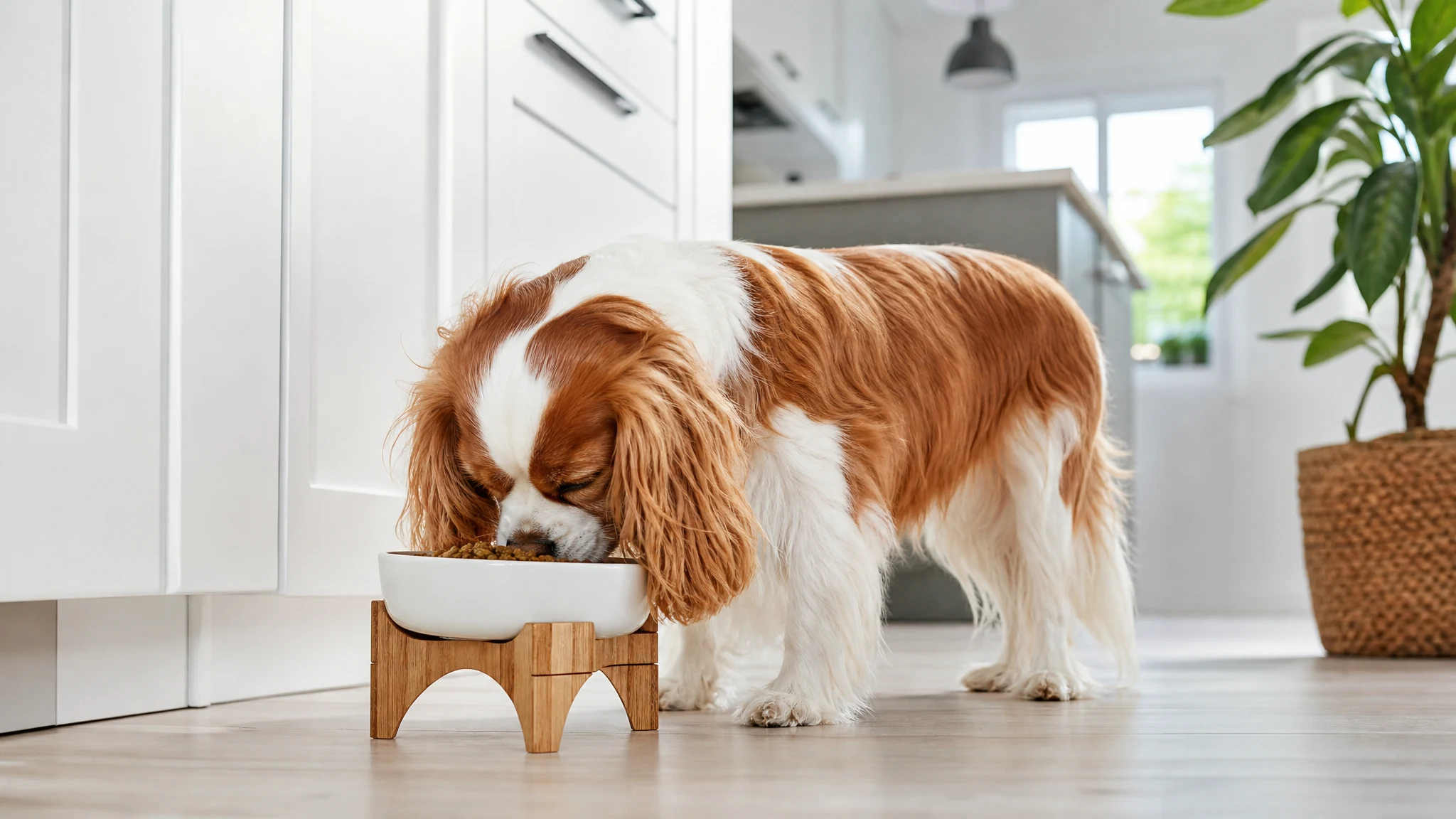
General nutrition information compiled from product labels and published sources, not veterinary advice. Your veterinarian is the right person to choose a diet for your dog, especially one with a health condition.
Owners often ask what's the best kind of food bowls for a Cavalier King Charles Spaniel. There is no single winner. The right bowl depends on your dog's size, how fast they eat, and how much food goes in at each meal.
This guide walks you through the choice in order: measure, pick a size, pick a material, set the height, and then check how it works at mealtime. We have not tested or fed any bowls ourselves. The advice here is general, practical reasoning, and we flag where your veterinarian should decide.
What You Need Before You Start
- A tape measure or ruler
- A kitchen scale, or a standard measuring cup, to portion meals
- Your dog's current weight (from a recent vet visit or a home scale)
- The feeding guide on your dog's food bag or the brand's own page
- A non-slip mat or tray, if you want to protect your floor
- A few bowl options to compare, such as stainless steel, ceramic or plain plastic
A Quick Look at the Dog You Are Buying For
The Westminster Kennel Club lists the Cavalier King Charles Spaniel as a toy breed with a maximum height of 13 inches and a maximum weight of 18 pounds. WebMD gives a typical adult range of 13 to 18 pounds. That is a small dog, so a bowl made for a large dog is rarely a good match.
Size matters for another reason. Royal Canin describes its Cavalier formula as shaped for the breed's slightly tapered muzzle and scissors bite. That tells you the muzzle shape is part of how food is designed for this breed. It is a reasonable cue to pay attention to how your own dog reaches into a bowl.
Step 1: Work Out How Much Food Goes in the Bowl
Bowl size starts with meal size. Look at the label guide for the food you feed. These are starting points, and they differ by brand:
- Victor lists its Hi-Pro Plus Small Breed Adult chart at 1 cup daily for 10 pounds and 1 1/2 cups daily for 15 pounds.
- Freshpet lists 1 to 1 1/4 cups daily for 11 to 15 pounds, and 1 1/4 to 1 2/3 cups for 16 to 20 pounds, either as one meal or split in two.
- Hill's Science Diet lists its Adult Small & Mini chart from 1/4 cup a day for a 2 pound dog up to 2 cups a day for a 25 pound dog.
- Royal Canin's Cavalier adult table runs from 11 to 20 pounds and changes by activity level (low, medium or high).
Divide the daily amount by the number of meals. A dog eating about 1 1/2 cups a day in two meals gets roughly 3/4 cup per bowl. For help setting the daily total, see our guide on how much to feed a Cavalier King Charles Spaniel.
If your dog has a health condition, confirm amounts with your veterinarian. Mitral valve disease is the most common health condition in the breed, according to WebMD, and weight and sodium are things a vet may want to discuss for an individual dog.
Step 2: Choose the Bowl Size
Pick a bowl that holds the meal with room to spare, but not so much room that it is huge. A good rule of thumb is a bowl that holds about two to three times the volume of one meal. Pour water into the bowl to check this using your measuring cup.
Think about width and depth too:
- Width: A bowl a little wider than your dog's muzzle lets them reach food without pressing their face against the sides.
- Depth: A shallow to medium bowl makes it easy to reach the last pieces. Very deep bowls can make small dogs push their head in at a awkward angle.
- Kibble size: Brands describe their kibble in general terms. Royal Canin's puppy food is described as easy for Cavaliers to pick up and chew. Victor and Hill's give no kibble dimensions for the small-breed foods listed, so check the brand for details.
For a puppy, you may want a smaller bowl first. Royal Canin's puppy feeding table runs from 2 to 9 months and uses target adult weights of 11, 15 or 18 pounds. Plan to move to a larger bowl as portions grow. Vetstreet says small dogs can generally move to adult food at around 90 percent of adult weight, typically around 9 to 12 months. Royal Canin's own Cavalier line moves to the adult formula after 10 months.
Step 3: Choose the Material
Each material has trade-offs. None of them is proven best for this breed, so pick on cleaning and durability.
Stainless steel
Easy to wash, hard to chip, and usually dishwasher safe. Look for a rubber ring on the base so it does not slide. Thin, light steel bowls can tip or skate across a floor.
Ceramic
Heavy, so it stays put. Check for chips and cracks, since damaged glaze can hold bacteria and sharp edges. Choose a glaze labeled food safe by the maker.
Plastic
Light and cheap. Scratches can build up over time and are harder to clean. Replace a bowl that looks scratched or smells after washing. Some dogs also chew plastic.
Silicone or collapsible bowls
Handy for travel. They are usually not stable enough for everyday use at home.
Whatever you choose, wash the bowl with warm soapy water after each meal. This matters most with wet or fresh food, such as Freshpet's refrigerated recipes or canned foods, which should not sit out. Follow the brand's storage directions.
Step 4: Set the Right Height
For most small dogs, a bowl on the floor is fine. A Cavalier stands up to 13 inches tall, so a floor bowl is within easy reach for most dogs.
If you are thinking of a raised feeder, measure first. A raised bowl should sit roughly at the level of your dog's lower chest, so your dog does not have to stretch up. Many owners of small dogs find a low stand of an inch or two is enough, if any.
Do not choose a raised bowl in hopes of preventing a medical problem. Nothing we found ties bowl height to any disease in this breed. If you have a concern about swallowing, regurgitation or posture at the bowl, ask your veterinarian before changing anything.
Step 5: Think About Eating Speed and Weight
CavalierHealth.org, an advocacy site, describes the breed as predisposed to obesity, citing a 1986 UK study. Because it is a secondary source, treat it as a reason to be careful rather than a firm rule. Weight control is something to discuss with your vet.
The bowl can help here in small ways:
- Use a measuring cup or scale every time. A bowl with no marks makes it easy to overfill.
- If your dog gulps, try a slow-feeder bowl with low ridges. Pick one with wide channels so your dog does not get frustrated.
- Do not leave food out all day unless your vet says to. Set meal times instead.
Small dogs usually need more calories per pound, according to Vetstreet, and may do well with several small meals. Smaller meals mean a smaller bowl is often enough.
Step 6: Test the Setup at Mealtime
- Place the mat in a quiet spot away from foot traffic.
- Measure the meal and pour it in.
- Watch how your dog eats for a few days. Look at posture, speed, and whether food ends up on the floor.
- Check whether the bowl slides, tips, or traps food in corners.
- Adjust the size, depth or height one thing at a time.
Tips for Better Results
- Keep a separate water bowl and wash it daily.
- Buy one bowl first and try it before buying a set.
- If you rotate foods, change slowly. Hill's suggests a 7 day transition on its small-breed foods.
- Re-measure the bowl and portion when your dog's weight changes.
- Read the label of the food too. The AAFCO statement tells you which life stage a food is made for. Royal Canin's Cavalier puppy food is labeled for growth including large dogs, while Victor's Hi-Pro Plus and Freshpet's small dog recipe are labeled for all life stages except growth of large-size dogs. For a Cavalier, whose adult weight is well under 70 pounds, Vetstreet notes that large-breed puppy calcium rules do not apply.
Common Mistakes to Avoid
- Buying a bowl that is too big. It can lead to overfilling.
- Using a damaged bowl. Chips, deep scratches and cracks are hard to clean.
- Skipping the non-slip base. A sliding bowl can make eating stressful.
- Filling by eye. Use a cup or scale.
- Raising the bowl without a reason. Ask your vet first if you think your dog needs it.
- Leaving wet or fresh food out. Follow the brand's storage directions.
- Making several changes at once. You will not know which one helped.
What Results to Expect
A well-chosen bowl may make meals tidier and easier to measure. Many dogs eat more comfortably when the bowl suits their size, and a slow-feeder bowl may help some fast eaters slow down. Results vary by dog.
A bowl will not change your dog's health on its own. Weight, heart health and diet are matters for your veterinarian, who decides what is right for an individual dog. If your dog coughs, gags, vomits or avoids the bowl, talk to your vet rather than buying a different bowl.
How We Compared Food Information
For the feeding examples above, we compared label data from the brands' own pages. We did not run feeding trials, taste tests or bowl tests. Check the current label on your dog's food before you set portions, because recipes and charts can change.
Sources
- Westminster Kennel Club, Cavalier King Charles Spaniel breed page
- WebMD, What to Know About Cavalier King Charles Spaniels
- CavalierHealth.org, diets page
- Vetstreet, transitioning your dog from puppy to adult food
- Royal Canin, Cavalier King Charles Adult
- Royal Canin, Cavalier King Charles Puppy
- Hill's Science Diet, Adult Small & Mini
- Freshpet, Small Dog Bite Size Chicken Recipe
- VICTOR, Hi-Pro Plus Small Breed Adult