Cavalier King Charles Spaniel Food Amount: A Feeding Chart by Age and Weight
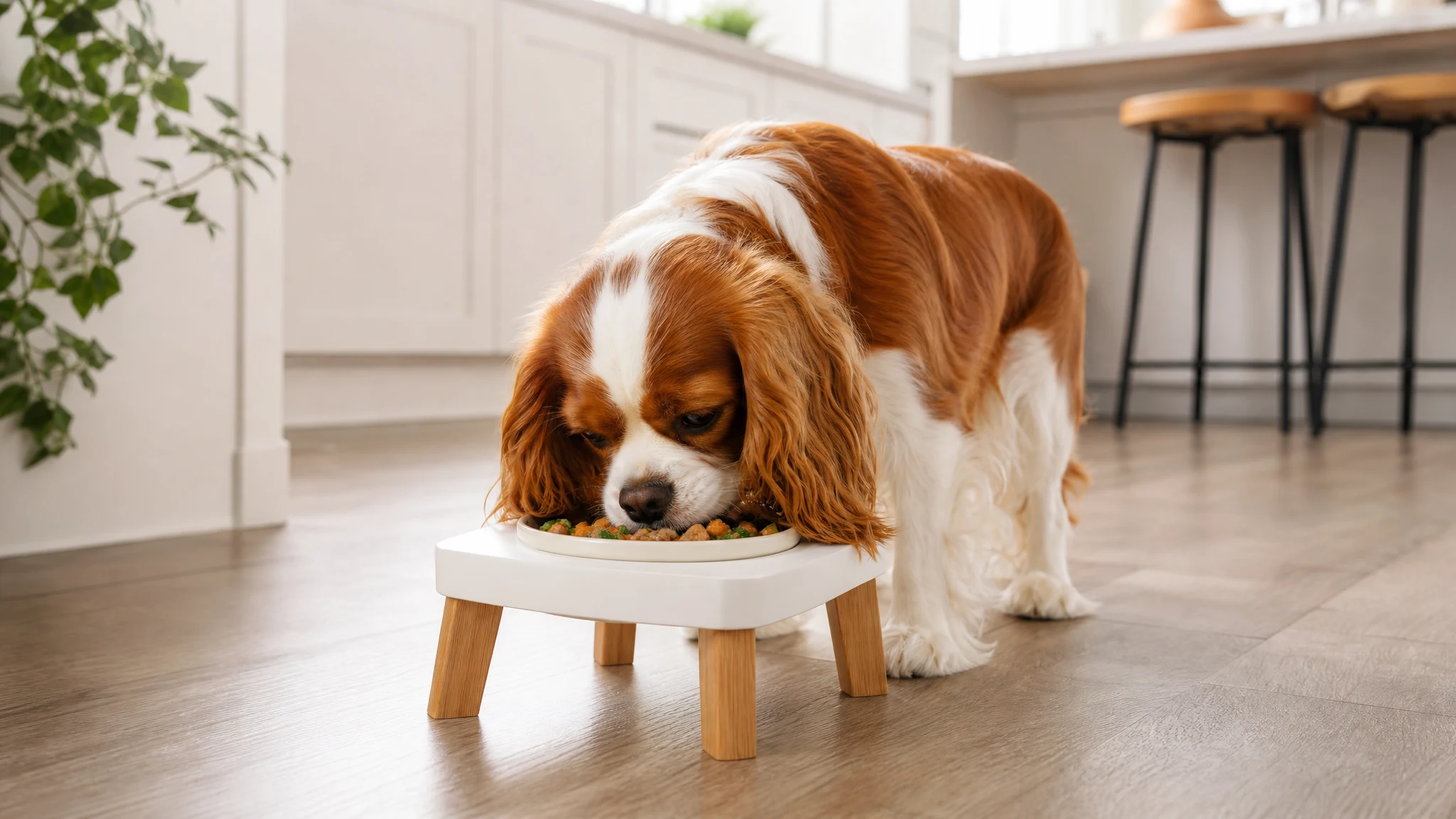
General nutrition information compiled from product labels and published sources, not veterinary advice. Your veterinarian is the right person to choose a diet for your dog, especially one with a health condition.
Working out the right cavalier king charles spaniel food amount is mostly a matter of reading one chart on the bag, then adjusting it to the dog in front of you. This guide shows how to do that, step by step.
We compared label data from several brands. We did not run feeding trials or taste tests, and the amounts below are label starting points, not prescriptions.
What Affects How Much a Cavalier Needs
The Westminster Kennel Club lists the Cavalier as a toy breed with a maximum weight of 18 pounds. WebMD describes adults as 13 to 18 pounds and 12 to 13 inches tall. That is a small body, so a few extra kibbles a day add up fast.
Vetstreet notes that small dogs usually need more calories per pound than large dogs. They may do better on calorie-dense food or several small meals. That is one reason a feeding chart by weight is only part of the picture.
Weight control also matters for this breed. CavalierHealth.org, a breed-health advocacy site, describes Cavaliers as predisposed to obesity. WebMD calls mitral valve disease, a heart condition, the most common health condition in the breed. Whether and how diet plays a role in any dog's heart health is a question for a veterinarian.
Materials You Will Need
- The feeding guide from your dog's food bag or the brand's own product page
- A standard dry measuring cup (not a coffee mug or scoop)
- A kitchen scale, if you want to weigh portions in grams
- A pet scale or a bathroom scale to weigh your dog
- A notebook or phone note for weights and portions
- The calorie figure for your food, listed as kcal per cup or per kg
Step-by-Step: Finding Your Cavalier's Daily Portion
Step 1: Weigh your dog
Weigh your Cavalier on the same scale each time. For a small dog, the easiest method is to weigh yourself holding the dog, then subtract your own weight. Write the number down.
Use the dog's current weight for adults. For puppies, many charts use the expected adult weight instead, so ask your veterinarian for an estimate.
Step 2: Find the calories in your food
Calories per cup vary a lot between foods. The same cup of two different foods can differ by more than 100 kcal. Here is what the brands' own pages list:
| Food | Type | Listed calories |
|---|---|---|
| Royal Canin Cavalier King Charles Adult | Dry, adult | 339 kcal ME per cup (calculated) |
| Royal Canin Cavalier King Charles Puppy | Dry, puppy | 368 kcal ME per cup (calculated) |
| Hill's Science Diet Adult Small & Mini Chicken & Brown Rice | Dry, adult | 357 kcal per cup |
| Hill's Science Diet Adult 11+ Small & Mini | Dry, senior | 378 kcal per cup |
| VICTOR Hi-Pro Plus Small Breed Adult | Dry, all life stages | 360 kcal per cup |
| VICTOR Hi-Pro Plus Small & Medium Breed Puppy | Dry, all life stages | 383 kcal per cup |
| Freshpet Small Dog Bite Size Chicken Recipe | Fresh | 267 kcal per cup (calculated) |
| Hill's Science Diet Puppy Small & Mini canned | Wet, puppy | 223 kcal per 5.8 oz can (per can, not per cup) |
If you switch foods, do not swap cup for cup. A cup of a lower-calorie food and a cup of a denser food are not the same meal.
Step 3: Read the brand's feeding chart
Find the row for your dog's weight. Here are the adult label guides we could compare, with the brand's own wording on how to use them.
| Dog weight | VICTOR Hi-Pro Plus Small Breed Adult | Freshpet Small Dog Bite Size Chicken |
|---|---|---|
| 5 lb | 0.5 cup per day | Check the brand's chart |
| 10 lb | 1 cup per day | Check the brand's chart |
| 11 to 15 lb | 15 lb is 1 1/2 cups per day | 1 to 1 1/4 cups per day |
| 16 to 20 lb | Check the brand's chart | 1 1/4 to 1 2/3 cups per day |
The two foods give different cup amounts for the same dog. That is expected, because their calories per cup differ widely. It is also why comparing cup amounts across brands tells you very little.
Hill's Science Diet Adult Small & Mini lists a chart running from 1/4 cup per day for a 2 pound dog up to 2 cups per day for a 25 pound dog. The brand says to adjust to maintain optimal weight. It also suggests a 7-day transition when changing foods.
Royal Canin's Cavalier King Charles Adult page has a daily feeding table by dog weight (11 to 20 pounds) and activity level (low, medium or high). The brand's Cavalier puppy page lists amounts by age (2 to 9 months) and target adult weight (11, 15 or 18 pounds). Open the brand's page to read the exact figures for your dog.
Step 4: Adjust for activity level
Some charts, such as Royal Canin's, split amounts by low, medium or high activity. If your Cavalier is a couch companion who walks twice a day, start with the low or medium column. A dog who hikes or plays hard most days may sit in the higher one.
Pick one column and stay with it for a few weeks before changing it.
Step 5: Split the portion into meals
Freshpet's chart says the daily amount can be given as one meal or split in two. For a small dog, two meals is a common choice, and Vetstreet notes that small dogs may do well with several small meals. Measure the whole day's amount in the morning and divide it, so nothing gets double-fed.
Step 6: Check body condition every two weeks
The chart is a starting point. Your dog's body tells you more. Run your hands along the ribs. You should be able to feel them under a thin layer of padding. Look from above for a visible waist behind the ribs.
If the ribs are hard to feel, reduce the portion slightly. If they are very easy to see, increase it slightly. Make small changes, then wait a couple of weeks before judging the result.
Feeding by Age
Puppies (about 8 weeks to 10 months)
Royal Canin's Cavalier puppy formula covers 8 weeks to 10 months, and the brand says to transition to its adult formula after 10 months. Its puppy page uses age and target adult weight. VICTOR's puppy recipe says that after age one, you should feed to maintain good body condition and use the chart as a guide.
Because adult Cavaliers stay well under 70 pounds, the large-breed puppy rules do not apply. Whole Dog Journal explains that growth and all-life-stages foods must carry one of two statements: one that includes growth of large size dogs (70 pounds or more as an adult), or one that excludes it. Small-breed puppies can eat either type. Several foods above carry the "except for growth of large size dogs" wording, which is fine for a Cavalier puppy.
Young adults (about 9 to 12 months onward)
Vetstreet gives general small-dog guidance that dogs can move to adult food at about 90 percent of adult weight, typically around 9 to 12 months. This is not Cavalier-specific, so confirm the timing with your veterinarian. When you switch, mix old and new food gradually over about a week, as Hill's suggests.
Seniors
Hill's lists an Adult 11+ Small & Mini formula at 378 kcal per cup. That is more calorie-dense than its adult recipe at 357 kcal per cup, so the cup amount for an older dog may need a closer look. Hill's says to adjust amounts as needed to maintain optimal weight. Older Cavaliers are also more likely to have health conditions that change what they should eat, which is a conversation for your veterinarian.
Tips for Getting It Right
- Count treats, chews and table scraps. For a dog under 20 pounds, they can make up a real share of the day's calories.
- Use treats from the daily portion when training, so the total stays the same.
- Re-weigh your dog monthly in the first year and every few months after that.
- Keep a note of the date you changed any portion, so you can link weight changes to the change.
- Check the full guide to how much to feed a Cavalier King Charles Spaniel for more on meal planning.
Common Mistakes to Avoid
- Filling the bowl and leaving it. Free feeding makes portions impossible to track.
- Using a scoop that came with a different food. Scoop sizes are not standard.
- Copying another brand's cup amount. As the table above shows, calories per cup vary widely.
- Treating the chart as a rule. Brands describe their charts as guides and tell you to adjust to maintain weight.
- Changing foods quickly. A gradual switch over about 7 days is the brand-suggested approach.
- Cutting food sharply for a heavy dog. Ask your veterinarian for a plan.
A Note on Health Conditions and Special Diets
If your Cavalier has a heart condition, a weight problem or any other diagnosis, confirm the amount and the food with your veterinarian before using any chart here. Prescription diets are something only a veterinarian prescribes. No over-the-counter food listed here is meant to prevent, treat or cure any disease.
The FDA's canine dilated cardiomyopathy (DCM) investigation page was last updated December 23, 2022. The agency said it would not post further public updates until there is meaningful new scientific information. If you are weighing a grain-free food, such as Freshpet's grain-free recipe, raise the question with your veterinarian and read the FDA page for yourself.
What Results to Expect
If you measure carefully and adjust in small steps, you may see a steady weight and a visible waist within a few weeks. Stools may become more consistent, and mealtimes may feel more predictable. Results vary by dog, and a portion that works for one Cavalier may be too much or too little for another.
If your dog gains or loses weight despite following the chart, or seems hungry all the time or uninterested in food, call your veterinarian rather than guessing.
Sources
- Westminster Kennel Club: Cavalier King Charles Spaniel breed page
- WebMD: What to know about Cavalier King Charles Spaniels
- CavalierHealth.org: Diets
- Vetstreet: Why size matters when transitioning your dog from puppy to adult food
- Whole Dog Journal: In the fine print, nutritional adequacy statements
- FDA: Investigation into potential link between certain diets and canine DCM
- Royal Canin: Cavalier King Charles Adult
- Royal Canin: Cavalier King Charles Puppy
- Hill's Science Diet: Adult Small & Mini
- Hill's Science Diet: Adult 11+ Small & Mini
- Hill's Science Diet: Puppy Small & Mini canned
- Freshpet: Small Dog Bite Size Chicken Recipe
- VICTOR: Hi-Pro Plus Small Breed Adult
- VICTOR: Hi-Pro Plus Small & Medium Breed Puppy