Cavalier King Charles Spaniel Dog Food: How Much and How Often
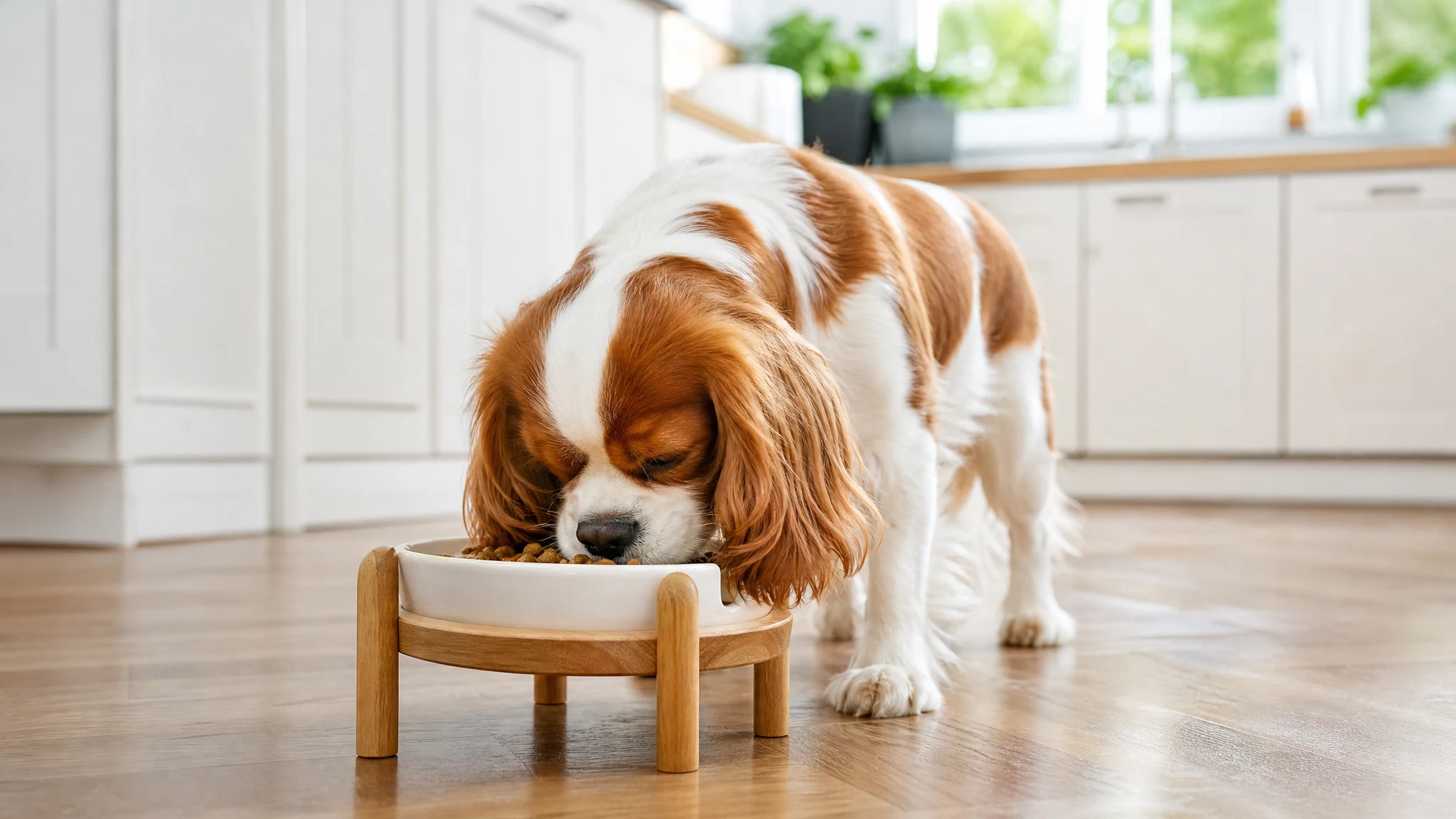
General nutrition information compiled from product labels and published sources, not veterinary advice. Your veterinarian is the right person to choose a diet for your dog, especially one with a health condition.
Working out the right amount of cavalier king charles spaniel dog food is mostly a matter of reading a label, weighing your dog and watching their body over a few weeks. No chart can know your dog's exact needs. A chart gives you a starting point, and you adjust from there.
This guide walks through that process in order. It covers what you need, how to find a starting amount, how to split it into meals and how to adjust. For a wider look at portions, see our page on how much to feed a Cavalier King Charles Spaniel.
How we approached this
We compared label data and the published feeding guides from the brands named below. We did not run feeding trials or taste tests, and we have not fed these foods to any dogs. The amounts here are label starting points, not prescriptions.
A quick look at the breed
The Westminster Kennel Club lists the Cavalier as a toy breed. WebMD gives the adult range as about 13 to 18 pounds, at 12 to 13 inches tall. The Westminster page lists a maximum weight of 18 pounds.
That small size matters for feeding. Vetstreet notes that small dogs usually need more calories per pound than larger dogs. They may do better on calorie-dense food or several small meals.
Weight also deserves attention in this breed. CavalierHealth.org, a breed-health advocacy site, describes Cavaliers as predisposed to obesity. WebMD calls mitral valve disease, a heart condition, the most common health condition in the breed. A veterinarian is the right person to discuss how diet and weight fit with heart health for your own dog.
Materials you will need
- A standard dry measuring cup, or better, a kitchen scale that reads in grams or ounces
- The bag, can or package of your dog's food, with the feeding guide and calorie statement
- A scale to weigh your dog. A home bathroom scale works if you weigh yourself, then weigh yourself holding the dog, and subtract.
- A notebook or phone note to record weight, amounts and treats
- Your veterinarian's contact details, for questions about your individual dog
Step 1: Confirm the food suits your dog's life stage
Start with the nutritional adequacy statement on the package. It tells you which life stage the food is built for.
Whole Dog Journal explains that AAFCO growth and all-life-stages foods must say either that they include growth of large size dogs (70 pounds or more as an adult), or that they exclude it. A Cavalier will not reach that size, so a puppy can eat either type.
Some examples from the brands' own pages:
- Royal Canin makes a Cavalier King Charles Puppy dry food for ages 8 weeks to 10 months. It also makes an Adult formula for purebred Cavaliers 10 months and older.
- Hill's Science Diet makes an Adult Small & Mini recipe for dogs up to 25 pounds when full grown, and an Adult 11+ Small & Mini recipe for seniors.
- VICTOR lists a Hi-Pro Plus Small & Medium Breed Puppy recipe and a Small Breed Adult recipe. Both carry the AAFCO all-life-stages statement that excludes growth of large size dogs.
Vetstreet says small dogs can generally move to adult food at about 90 percent of adult weight, typically around 9 to 12 months. That is general small-dog guidance, not Cavalier-specific, so confirm the timing with your veterinarian.
Step 2: Find the calories per cup
Every food packs a different amount of energy into a cup. A cup of one food is not a cup of another. Check the calorie statement before you scoop.
| Food (per the brand's page) | Form | Calories listed |
|---|---|---|
| Royal Canin Cavalier King Charles Adult | Dry | 339 kcal ME per cup (calculated) |
| Royal Canin Cavalier King Charles Puppy | Dry | 368 kcal ME per cup (calculated) |
| Hill's Science Diet Adult Small & Mini Chicken & Brown Rice | Dry | 357 kcal per cup |
| Hill's Science Diet Adult 11+ Small & Mini | Dry | 378 kcal per cup |
| VICTOR Hi-Pro Plus Small Breed Adult | Dry | 360 kcal per cup |
| VICTOR Hi-Pro Plus Small & Medium Breed Puppy | Dry | 383 kcal per cup |
| Freshpet Small Dog Bite Size Chicken | Fresh | 267 kcal per cup (calculated) |
Hill's lists its canned Puppy Small & Mini entree at 223 kcal per 5.8 ounce can, so that one is measured by the can, not the cup.
The Freshpet cup is lighter in calories, so a Cavalier on that food will be fed a larger volume than on a calorie-dense kibble. The numbers are not interchangeable.
Step 3: Find the starting amount by weight, age and activity
Weigh your dog, then look up that weight on the feeding chart for your food. The charts below are the label guides published by each brand.
- Royal Canin Adult: a daily table by dog weight (11 to 20 pounds) and activity level (low, medium or high). Check the brand's page for the exact figures.
- Royal Canin Puppy: a daily table by puppy age (2 to 9 months) and target adult weight (11, 15 or 18 pounds).
- Hill's Adult Small & Mini: the chart runs from 1/4 cup per day for a 2 pound dog to 2 cups per day for a 25 pound dog. Hill's says to adjust to maintain optimal weight.
- VICTOR Small Breed Adult: the chart lists 1 cup daily at 10 pounds and 1 1/2 cups at 15 pounds.
- Freshpet Small Dog: 1 to 1 1/4 cups daily for 11 to 15 pounds, and 1 1/4 to 1 2/3 cups for 16 to 20 pounds.
If your dog is a typical adult Cavalier, the chart row for their current weight is your starting point. A less active dog usually sits at the lower end of a range. A very active dog may sit at the higher end. For a puppy, use the age and target adult weight rows, and ask your veterinarian what adult weight is realistic for your dog.
These figures are the amount for the whole day, not per meal. Do not serve the full daily amount at each feeding.
Step 4: Split the day's food into meals
Vetstreet says small dogs may do better with several small meals. Freshpet's guide says the daily amount can be given as one meal or split in two. Most adult Cavalier owners choose two meals, morning and evening, at consistent times.
For a young puppy, the brand pages we reviewed give daily amounts but not a meal count. Ask your veterinarian how many meals to offer at each age, and how to reduce them as your puppy grows.
- Measure the full day's amount once, ideally in the morning.
- Divide it into the number of meals your veterinarian suggests, with two being common for adults.
- Keep the portions in a small container so the day's total stays fixed.
- Feed at the same times each day and pick up uneaten food after a short while.
Step 5: Count treats and extras
Training treats, chews and table scraps all add calories. In a dog of 13 to 18 pounds, a few extra bites make up a larger share of the day than they would in a big dog.
Use a small part of the daily kibble as training rewards when you can. Write down any other treats. If your dog gets many, trim the meals a little. Ask your veterinarian how much to trim, especially if your dog has a health condition.
Step 6: Switch foods slowly
Hill's recommends transitioning over 7 days. Mixing a growing share of the new food into the old food over about a week is a common approach. If your dog has loose stools or refuses food during the switch, slow down and call your veterinarian.
When you change foods, recheck the calories per cup. The cup amount will likely change even if the number of calories stays the same.
Step 7: Check body condition and adjust
Weigh your dog every two to four weeks at first and record it. Then look and feel.
- You should be able to feel the ribs under a thin layer of padding without pressing hard.
- From above, there should be a visible waist behind the ribs.
- From the side, the belly should tuck up slightly.
If your dog is gaining, cut the daily amount by a small step, such as a spoonful, and recheck in two weeks. If your dog is thin or low on energy, do not simply add food. Call your veterinarian first, because weight loss can have medical causes.
Hill's and VICTOR both frame their charts as guides to adjust until your dog holds a good body condition. That is the right way to read every chart.
Common mistakes to avoid
- Feeding by eye. A scoop that looks small can be quite a bit over the label amount. Level the cup or weigh it.
- Using the cup from another food. Calories per cup differ between brands, as the table shows.
- Ignoring treats. They count toward the day's total.
- Assuming the chart is exact. Charts are averages. Your dog's metabolism and activity may differ.
- Keeping puppy food too long. Move to an adult formula on the schedule your veterinarian agrees with.
- Changing the diet because of a heart worry without asking. If your Cavalier has a heart diagnosis, the food and amount are a conversation with your veterinarian. A grocery shelf claim does not settle it.
- Chasing a grain-free label. The FDA has investigated a possible link between certain diets and canine dilated cardiomyopathy. Its latest update was December 23, 2022, and it said it will not post further updates until there is meaningful new scientific information. The FDA's figures cover January 1, 2014 through April 30, 2019. Ask your veterinarian what this means for your dog.
Special cases: confirm with your vet
If your Cavalier has mitral valve disease, a food allergy, a weight problem or any other health condition, confirm both the food and the amount with your veterinarian. No label chart accounts for a medical condition. Foods made for medical conditions are prescription diets, which only a veterinarian can prescribe.
The same goes for supplements. This article gives no supplement amounts. Ask your veterinarian before adding any.
What to expect
If you measure carefully and adjust, many owners find that their dog keeps a steadier weight over time and that meals become predictable. Results vary by dog. Good feeding habits may help you notice changes early, such as slow weight gain, but they do not replace regular veterinary checkups. Nothing in a feeding routine can prevent or treat a disease.
Expect to adjust. Weight, age and activity change, so the right amount this year may not be right next year.
Quick checklist
- Pick a food that matches your dog's life stage.
- Note the calories per cup.
- Weigh your dog and find the chart row.
- Split the daily amount into meals.
- Count treats.
- Check weight and body shape every few weeks.
- Ask your veterinarian about any health concern.
Where to check brand details
Brands update recipes and charts. Before you rely on a number, check the current page for Royal Canin Cavalier King Charles Adult, Hill's Science Diet Adult Small & Mini, VICTOR Hi-Pro Plus Small Breed Adult or Freshpet Small Dog Bite Size Chicken Recipe.
Sources
- Westminster Kennel Club, Cavalier King Charles Spaniel breed page
- WebMD, What to Know About Cavalier King Charles Spaniels
- Vetstreet, Why Size Matters When Transitioning Your Dog from Puppy to Adult Food
- CavalierHealth.org, diets page
- Whole Dog Journal, In the Fine Print: Nutritional Adequacy Statements
- FDA Center for Veterinary Medicine, canine dilated cardiomyopathy investigation
- Royal Canin, Cavalier King Charles Puppy
- Hill's Science Diet, Adult 11+ Small & Mini
- VICTOR, Hi-Pro Plus Small & Medium Breed Puppy