Cavalier King Charles Spaniel Adult Food Portion: How Much Is Right?
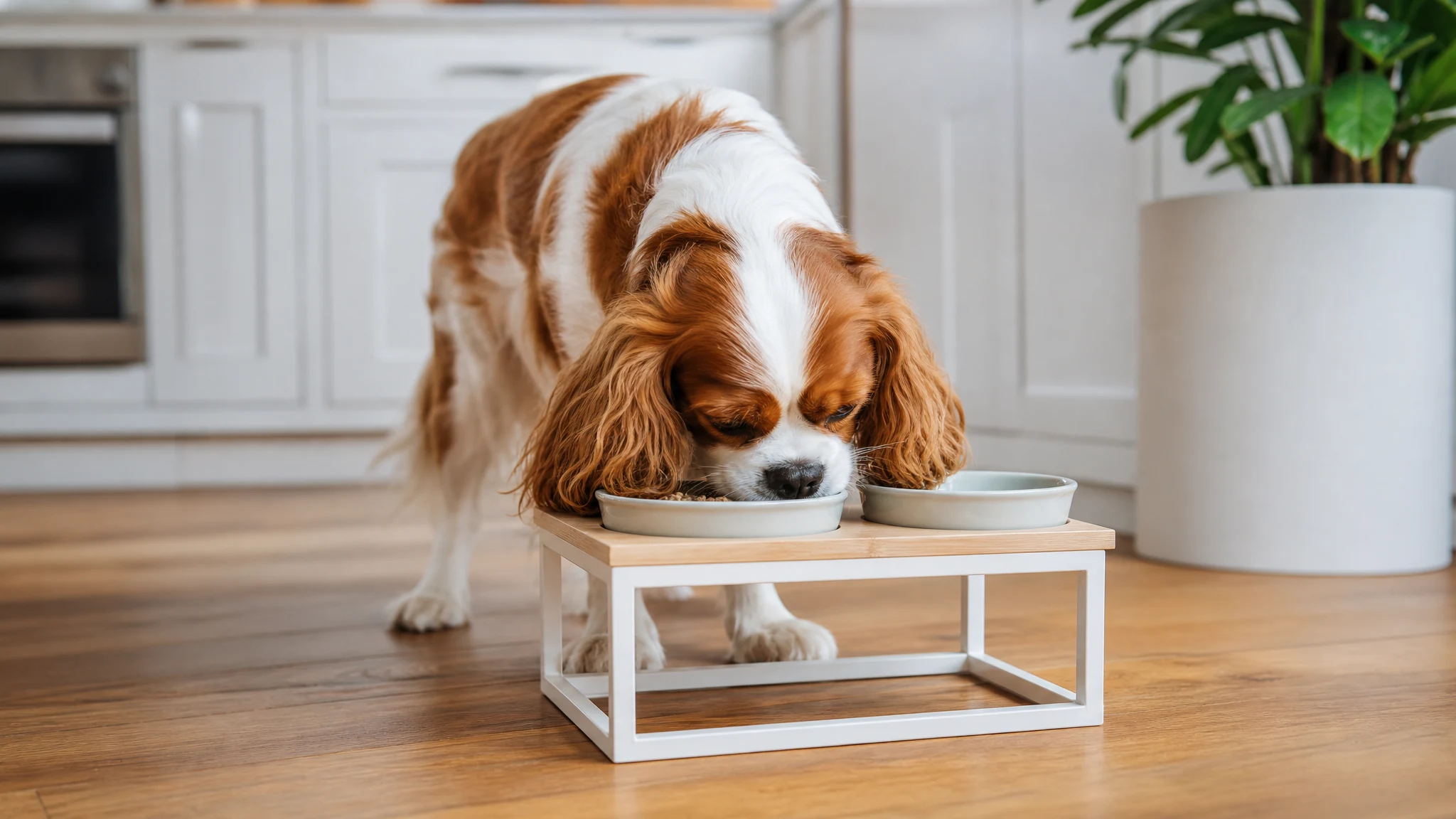
General nutrition information compiled from product labels and published sources, not veterinary advice. Your veterinarian is the right person to choose a diet for your dog, especially one with a health condition.
Working out the right Cavalier King Charles Spaniel adult food portion is less about one magic number and more about a repeatable routine. You start with the label guide, measure carefully, watch your dog's body, and adjust in small steps.
This guide walks through that routine. It also shows how far apart different foods can be, so a cup of one food is never assumed to equal a cup of another.
For the wider picture, see our full guide to how much to feed a Cavalier King Charles Spaniel.
Why portions matter for this breed
The Westminster Kennel Club lists the Cavalier as a toy breed, with a maximum weight of 18 pounds and a maximum height of 13 inches. WebMD describes adults as 13 to 18 pounds. At that size, a few extra kibbles a day make up a real share of the daily total.
Two health points make portions worth taking seriously. WebMD calls mitral valve disease, a heart condition, the most common health condition in the breed. CavalierHealth.org, an advocacy site, describes the breed as predisposed to obesity and cites a 1986 UK study for that claim.
Food does not treat or cure a heart condition. What a veterinarian can do is look at your individual dog's weight, heart status and diet together. If your Cavalier has any health condition, confirm amounts with your vet before changing anything below.
Materials you need
- The bag, can or package of the food you feed, with its feeding guide and calorie statement.
- A standard dry measuring cup or a kitchen scale. Scoops that come free in the bag vary, so do not rely on them.
- A bathroom scale or a vet-clinic scale to track your dog's weight.
- A notebook or phone note to record weight, portions and treats.
- A feeding bowl, and a slow-feeder or puzzle bowl if your dog gulps.
Step-by-step: finding your dog's portion
Step 1: Confirm your dog is ready for adult food
Vetstreet explains that small dogs can generally move to adult food at about 90 percent of their expected adult weight, often around 9 to 12 months. That is general small-dog guidance, not specific to Cavaliers, so your vet should confirm the timing.
Royal Canin's Cavalier puppy formula says to move to its adult formula after 10 months. Check the brand's own page for the food you use.
Step 2: Weigh your dog
Feeding guides run on weight, so you need a real number. Weigh yourself holding your dog, then weigh yourself alone, and subtract. A Cavalier in the 13 to 18 pound range sits in the middle of most small-breed feeding charts.
Write the number down with the date.
Step 3: Read the label's feeding chart
Find the chart for your dog's weight and, if the food offers it, activity level. Treat the figure as a starting point. Labels are written for an average dog, and your Cavalier may need a little more or less.
Here is how published guides compare for small dogs, as stated on each brand's page:
| Food | Calories on the label | Label guide |
|---|---|---|
| Royal Canin Cavalier King Charles Adult (dry) | 339 kcal per cup | Daily table for 11 to 20 lb, split by low, medium or high activity |
| Hill's Science Diet Adult Small & Mini Chicken & Brown Rice (dry) | 357 kcal per cup | 1/4 cup a day for a 2 lb dog up to 2 cups a day for a 25 lb dog |
| VICTOR Hi-Pro Plus Small Breed Adult (dry) | 360 kcal per cup | 0.5 cup at 5 lb, 1 cup at 10 lb, 1 1/2 cups at 15 lb |
| Freshpet Small Dog Bite Size Chicken Recipe (fresh) | 267 kcal per cup | 1 to 1 1/4 cups at 11 to 15 lb; 1 1/4 to 1 2/3 cups at 16 to 20 lb |
The Royal Canin and Hill's pages are the ones to open for their full charts. We compared label data only. We did not run feeding trials or taste tests, and this is not a ranking.
Step 4: Turn cups into calories
Cups are not a fair way to compare foods. Using the labels above, a 15 pound dog fed VICTOR's chart amount of 1 1/2 cups at 360 kcal per cup works out to about 540 kcal a day. The same dog fed Freshpet's 1 to 1 1/4 cups at 267 kcal per cup works out to roughly 267 to 334 kcal a day.
The cup amounts look similar, but the calorie totals are not. This is simple arithmetic from the labels, and each brand's chart is built for its own food. The lesson is to follow the chart on the food in your bowl, not a figure from another bag.
If you switch foods, recalculate from the new label. Do not carry the old cup amount over.
Step 5: Measure and split the day's food
Level the cup or weigh the food, and put the day's total in a container. Subtract anything given as treats or chews that day.
Vetstreet notes that small dogs may do better with calorie-dense food or several small meals. Two meals a day is a common routine for adults, and Freshpet's guide says its daily amount can be fed as one meal or split in two. A third small meal is something to ask your vet about if your dog seems hungry or has an upset stomach between meals.
Step 6: Check body condition every two weeks
The scale is only half the story. Run your hands along your dog's ribs. You should be able to feel them under a thin layer of padding without pressing hard. From above, you should see a waist behind the ribs. If the ribs are buried or the waist is gone, the portion may be too much.
Weigh again and write the number next to the date. Feathered Cavalier coats can hide weight gain, so hands matter more than eyes here.
Step 7: Adjust in small steps
If your dog is gaining, trim the daily amount by a small amount, such as a spoonful at a time, and recheck in two weeks. If your dog is thinning or very hungry, raise it slightly and recheck. Large jumps make it hard to see what worked.
Your vet can set a target weight and a calorie goal. That matters most if your dog has heart disease, since your vet may want to track weight and appetite closely.
Tips that make portions easier
- Count treats. Keep them to a small share of the day's food and take them out of the meal portion.
- Use part of the meal for training. Reward-based training works well with kibble from the bowl, which keeps calories steady.
- Pick the right life stage. A food made for adult maintenance fits an adult Cavalier. Puppy foods run richer. For example, Royal Canin's puppy formula lists 368 kcal per cup against 339 for its adult formula.
- Keep one feeder. When several family members feed the dog, agree on one measured amount and one person who logs it.
- Read the nutritional adequacy statement. Look for wording that says the food meets AAFCO nutrient profiles for adult maintenance or all life stages. Whole Dog Journal notes that all-life-stages foods must also say whether they cover growth of large-size dogs. That wording does not matter for a Cavalier at 18 pounds or less.
Common mistakes to avoid
- Eyeballing scoops. A heaped cup can hold a lot more food than a level one.
- Forgetting calories from extras. Chews, dental sticks, table scraps and food used for medication all add up.
- Feeding to the top of the chart. The upper figure in a weight range suits a more active dog. A calm lap dog may need less.
- Following the dog's begging. Many Cavaliers are enthusiastic eaters. Appetite alone does not tell you the portion is too small.
- Switching foods suddenly. Hill's, for example, suggests a 7 day transition on its Small & Mini adult page. Mix the new food in gradually.
- Treating an online DCM story as a reason to change diet alone. The FDA's canine dilated cardiomyopathy page was last updated December 23, 2022, and the agency said it would not post further public updates until there is meaningful new scientific information. Ask your vet about your own dog's diet and heart health rather than switching on your own.
Adjusting for age and activity
Royal Canin's adult table separates dogs by low, medium and high activity, which is a useful reminder that a daily walker and a sofa companion may not need the same amount. Hill's lists a separate Small & Mini formula for dogs 11 and older, at 378 kcal per cup, and says to adjust amounts as needed to maintain optimal weight.
A senior Cavalier may move less and need fewer calories, or may be losing weight and need more. Either change is a reason to call the vet, since weight loss or a change in appetite can have medical causes.
What to expect
If the portion is about right, your dog may hold a steady weight, keep a visible waist and finish meals with normal interest. Over a few weeks of careful measuring, many owners find that their dog's weight settles. Results vary by dog, and no feeding routine can promise a specific outcome.
If your dog's weight keeps climbing or dropping after two to four weeks of careful measuring, or you see coughing, tiring easily or changes in breathing, talk to your veterinarian. Those signs are not something to manage with portion tweaks.
A quick checklist
- Confirm your dog is ready for adult food.
- Weigh your dog and write it down.
- Find the label chart for that weight.
- Compare calories per cup, not just cups.
- Measure level cups or grams, and subtract treats.
- Check ribs and waist every two weeks.
- Adjust in small steps and review with your vet.
For brand-specific details such as ingredients and full feeding tables, use the manufacturer pages listed below, since labels can change.
Sources
- Westminster Kennel Club, Cavalier King Charles Spaniel breed page
- WebMD, what to know about Cavalier King Charles Spaniels
- CavalierHealth.org, diets page
- Vetstreet, transitioning from puppy to adult food
- Whole Dog Journal, nutritional adequacy statements
- FDA Center for Veterinary Medicine, canine DCM investigation
- Royal Canin, Cavalier King Charles Adult
- Hill's Pet, Science Diet Adult Small & Mini
- VICTOR, Hi-Pro Plus Small Breed Adult
- Freshpet, Small Dog Bite Size Chicken Recipe