Best Training Treats for Cavalier King Charles Spaniels (and How Many to Give)
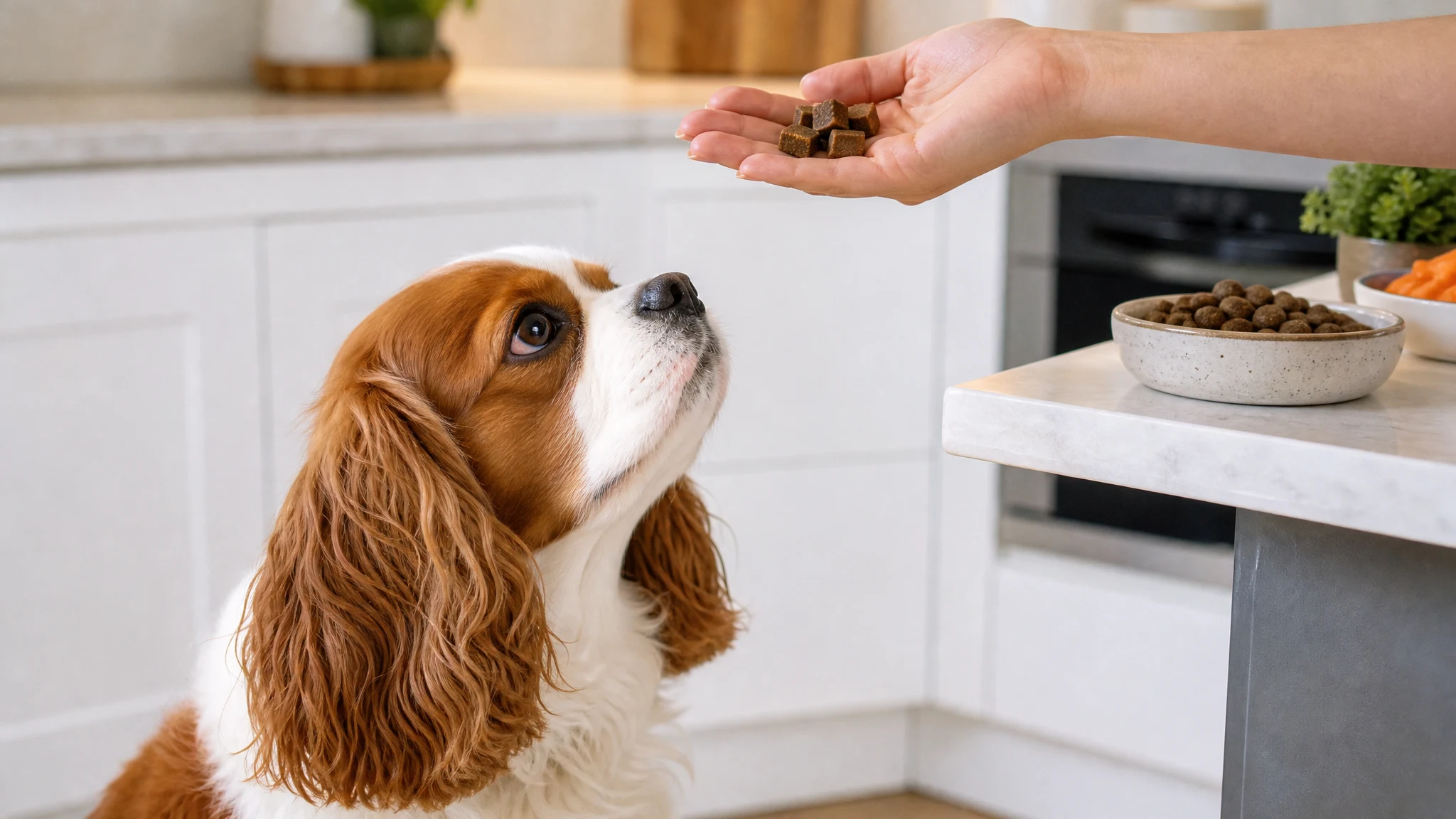
General nutrition information compiled from product labels and published sources, not veterinary advice. Your veterinarian is the right person to choose a diet for your dog, especially one with a health condition.
Cavalier King Charles Spaniels are eager to please and love food. That makes training easy, and it also makes extra calories easy to hand out without noticing.
This guide shows how to choose training treats for a Cavalier King Charles Spaniel, how small to make them, and how to count them against the daily food budget. It is built around categories of treats, not brand rankings. We did not feed-test or taste-test any treats. What follows is based on label reading and published guidance.
Why treat choice matters for this breed
The Westminster Kennel Club lists the Cavalier as a toy breed, and WebMD gives an adult size of 13 to 18 pounds at 12 to 13 inches tall. A dog this small has a small calorie budget. A few handfuls of treats can be a large share of a day's food.
Weight is also worth watching for health reasons. The CavalierHealth.org diets page describes the breed as predisposed to obesity, citing a 1986 UK study. It is an advocacy site, so treat that as a reason to be careful, not as a settled figure.
WebMD calls mitral valve disease the most common health condition in the breed. If your dog has a heart diagnosis, ask your veterinarian which treats suit your dog, including how much sodium is appropriate. A veterinarian decides that for an individual dog, and no treat can prevent or treat a heart condition.
What you need
- Two or three treat types from different categories (see below).
- A treat pouch or small container, so treats are portioned before training starts.
- A kitchen scale or measuring spoon for the daily food.
- Your dog's daily calorie target from your veterinarian.
- The calorie figure from each treat package (usually listed per treat or per piece, or per cup, ounce or gram).
- A pair of scissors or a knife for cutting treats down.
The three treat categories worth knowing
There is no single best treat. The best treats for Cavalier King Charles Spaniels are the ones your dog works for, that you can break into tiny pieces, and that your dog tolerates well. These three categories cover most training needs.
Soft training treats
Soft, moist treats are easy to tear into small pieces and are quick to swallow, so training does not stall while your dog chews. They are a practical default for short sessions.
Read the label. Calories per treat vary a lot between brands, and some soft treats are quite rich. Choose one where you can tell how many calories sit in a single piece.
Freeze-dried single protein treats
These are made from one animal protein, such as one type of meat. A short ingredient list makes it easier to see what your dog is eating, which helps if you are trying to keep track of what agrees with your dog. They are usually light and crumbly, and they can be broken into small bits.
Because they are strongly flavored, many owners save them for harder jobs, like recall practice outdoors. Check the label for calories, since small pieces of freeze-dried meat can still add up.
Vegetables
Some dogs will work for small pieces of plain vegetables, such as carrot. They can be a lower-calorie option for easy repetitions at home. Not every dog finds them exciting, and some foods people eat are unsafe for dogs, so check with your veterinarian before offering anything unfamiliar. Keep pieces small, plain and unseasoned.
Step-by-step: choosing and using training treats
Step 1: Get a daily calorie target from your veterinarian
The treat budget depends on the total daily calories, and that depends on your dog's age, weight, body condition and activity. Ask your veterinarian for a number rather than guessing. The feeding guide on a bag of food is a starting point only. For example, the Royal Canin Cavalier King Charles Adult page lists a daily feeding table for dogs from 11 to 20 pounds by activity level, and it states 339 kcal per cup as fed. Your veterinarian can help you adjust from there.
Step 2: Apply the 10 percent rule
The World Small Animal Veterinary Association (WSAVA) guidance commonly cited for pet owners is that treats should make up no more than about 10 percent of a dog's daily calories. The rest should come from a complete and balanced diet.
Here is a made-up example to show the arithmetic. If your veterinarian says a dog needs 400 calories a day, then 10 percent is 40 calories for all treats that day. Use your own dog's number, not this one.
Treat calories are part of the day's total, not extra on top. If treats use up 40 calories, the meals should be reduced to match, so the daily total stays the same. Ask your veterinarian how much to trim.
Step 3: Read the calorie line on the treat package
Find the calories per treat, or per piece, ounce or gram. If the package gives calories for a whole bag or per cup, you will need to estimate per piece. Count how many pieces you get after cutting, and divide.
If you cannot find a calorie figure, contact the brand. Do not assume it is low.
Step 4: Cut treats to a very small size
For a dog this size, aim for pieces about the size of a pea or smaller. Your dog is rewarded by the taste and the moment, not the volume. Smaller pieces also let you run more repetitions without going over the budget.
No source we relied on gives a standard treat size for Cavaliers, so this is a practical rule of thumb. If you have a very young puppy, go smaller still and ask your veterinarian what is safe.
Step 5: Count the day's treats before you start
Work out how many pieces fit in the budget. For example, if the budget is 40 calories and a cut piece is about 2 calories, that is roughly 20 pieces. Put that many in your pouch. When the pouch is empty, treat time is over.
Count everything: treats from visitors, dental chews, and the bits of cheese used to hide a pill.
Step 6: Use part of the regular meal as treats
On easy days, pull kibble from your dog's regular daily portion and use it as the reward. This costs no extra calories at all. Dry foods differ in calories per cup. For example, the VICTOR Hi-Pro Plus Small Breed Adult lists 360 kcal per cup, so check your own food's label for the figure.
For more on matching a complete food to a Cavalier, see our guide to dog foods for Cavalier King Charles Spaniels.
Step 7: Match the treat to the job
Use the lowest-value reward that still works. Kibble or a vegetable piece suits easy skills at home. Soft treats suit new skills. Save freeze-dried meat for distracting places. This keeps your high-value treats exciting and keeps calories down.
Step 8: Reward quickly and train humanely
Deliver the treat within a second or two of the behavior you want. Keep sessions short, a few minutes at a time. This follows the reward-based approach supported by the American Veterinary Society of Animal Behavior (AVSAB). Do not use corrections or punishment to get behavior. Treats work best when training stays pleasant for your dog.
Step 9: Check body condition regularly
Weigh your dog on a schedule your veterinarian suggests, and ask them to show you how to judge body condition by feel. If your dog is gaining, reduce the treats and meals together and talk with your veterinarian. Do not wait for the problem to be obvious.
Tips
- Introduce one new treat at a time, in a small amount, so you can tell what agrees with your dog.
- Look for "treats" or "snacks" language on labels. Treats are not complete diets and are not meant to replace meals.
- Keep a note on the fridge of the day's treat budget so everyone in the home follows it.
- If your dog has a heart condition or other diagnosis, ask your veterinarian before changing treats, especially if sodium is a concern.
- Store soft treats as the package directs so they stay fresh.
Common mistakes to avoid
- Cutting nothing. Whole-size treats use the budget in a handful of repetitions.
- Adding treats without trimming meals. This is how weight creeps up.
- Ignoring calories on the label. "Natural" or "healthy" on the front says nothing about calories per piece.
- Using the same treat for everything. Your dog may lose interest, and you may reach for bigger portions.
- Treating the 10 percent rule as a target. It is a ceiling. Many sessions need far less.
- Giving human food without checking. Some common foods are unsafe for dogs. Ask your veterinarian.
What to expect
With small, well-timed rewards, many Cavaliers learn basic cues quickly, since the breed is often motivated by food and attention. Results vary by dog and by how consistent the training is.
Keeping treats within a set budget may help keep your dog's weight steady, though weight depends on the whole diet and activity. Your veterinarian is the right person to judge whether your dog's weight and treat plan are on track.