Adult Cavalier King Charles Spaniel Feeding Portions Explained
General nutrition information compiled from product labels and published sources, not veterinary advice. Your veterinarian is the right person to choose a diet for your dog, especially one with a health condition.
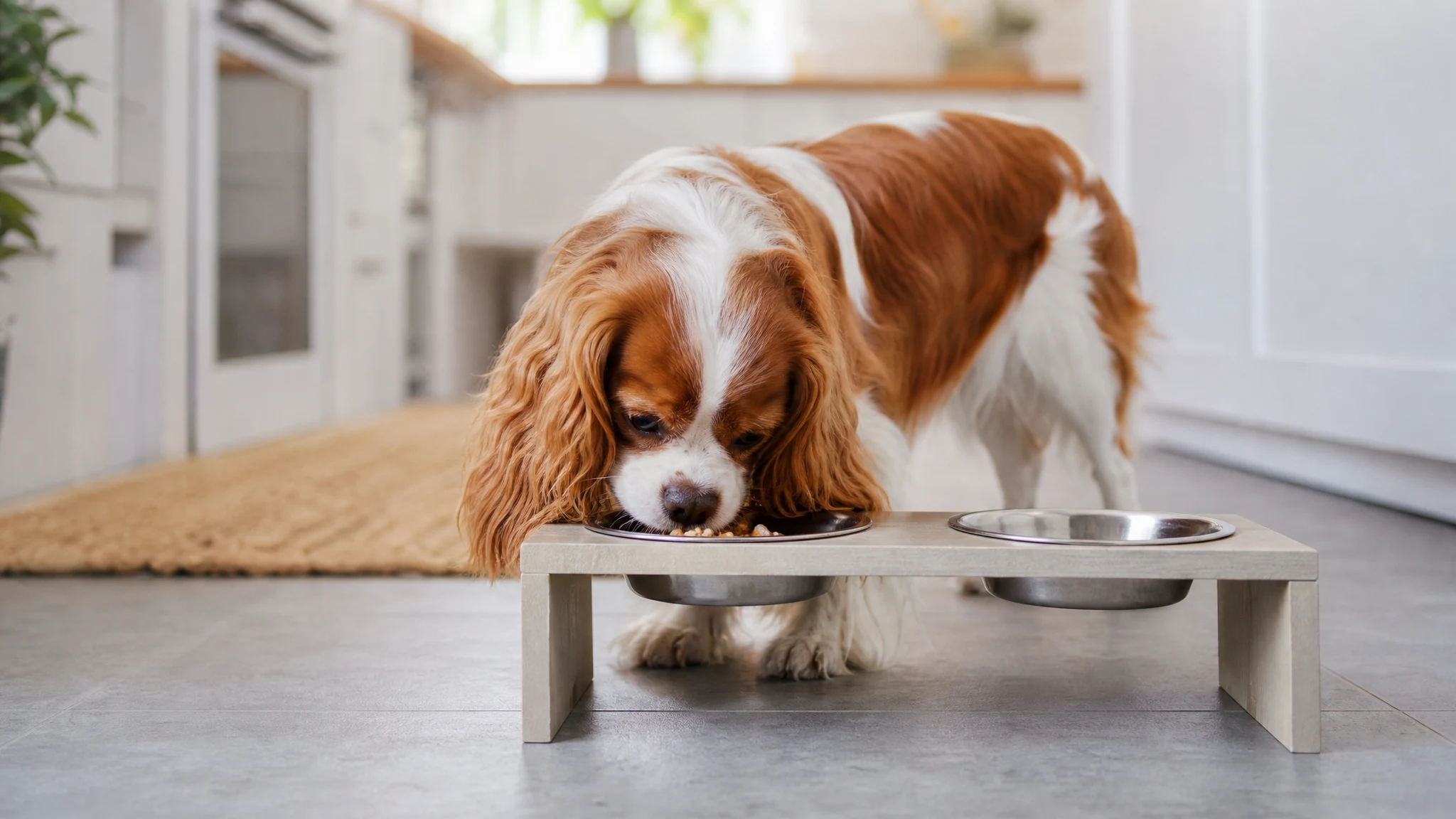
Getting a cavalier king charles spaniel adult food portion right is mostly a measuring job. The bag gives a starting number. Your dog's body shape tells you whether that number is working.
This guide walks through the steps. We compared label data and published feeding charts from the brands named below. We did not run feeding trials or taste tests, so treat every number here as a starting point, not a prescription.
Why portions matter for this breed
The Westminster Kennel Club lists the Cavalier as a toy breed. WebMD describes adults as about 13 to 18 pounds and 12 to 13 inches tall. On a frame that small, a few extra kibbles a day add up quickly.
CavalierHealth.org, a breed-health advocacy site, describes the breed as predisposed to obesity. It cites a 1986 UK study for that claim. WebMD calls mitral valve disease, a heart condition, the most common health problem in the breed. CavalierHealth.org says Cavaliers are over twenty times more likely to develop it than other breeds.
Food does not prevent or treat that heart condition. What you can do is keep portions steady and watch weight. Whether your own dog needs a special diet is a decision for your veterinarian.
What you need
- A standard dry measuring cup, or better, a kitchen scale that reads in grams or ounces
- The food's bag or the brand's product page, with its feeding chart and calories per cup
- A current weight for your dog (a vet visit scale or a bathroom scale method works)
- A notebook or phone note for tracking meals, treats and weight
- Your veterinarian's contact details for questions about your dog's health
Step 1: Confirm your dog is ready for adult food
Vetstreet notes that small dogs can generally move to adult food at about 90 percent of their adult weight, often around 9 to 12 months. That is general small-dog guidance, not Cavalier-specific, so confirm the timing with your veterinarian.
Royal Canin's breed-specific adult formula is labeled for purebred Cavaliers 10 months and older. Its puppy formula tells owners to transition to the adult version after 10 months.
Make the switch gradually. Hill's suggests transitioning over 7 days on its small-breed adult page, which is a reasonable pace for most foods.
Step 2: Get an honest current weight
Weigh your dog before you open the feeding chart. Charts run by weight, so a guess that is two pounds off can move the portion noticeably for a dog this size.
Use the weight your dog is now, not the weight you hope for. If your veterinarian has told you your dog is overweight, ask for a target weight and ask which chart row to use.
Step 3: Read the feeding chart on the label
Every product has its own chart, and the amounts differ because the foods differ in calories. Here is what each brand's published guide says for dogs in the Cavalier weight range.
| Food | Calories on the label | What the chart says |
|---|---|---|
| Royal Canin Cavalier King Charles Adult (dry) | 339 kcal ME per cup, as fed (calculated) | Daily table by weight (11 to 20 lb) and activity level (low, medium, high) |
| Hill's Science Diet Adult Small & Mini Chicken & Brown Rice (dry) | 357 kcal per cup | From 1/4 cup per day for a 2 lb dog to 2 cups per day for a 25 lb dog; adjust to maintain optimal weight |
| VICTOR Hi-Pro Plus Small Breed Adult (dry) | 360 kcal per cup | 5 lb at 0.5 cup daily, 10 lb at 1 cup, 15 lb at 1 1/2 cups |
| Freshpet Small Dog Bite Size Chicken Recipe (fresh) | 267 kcal per cup (calculated) | 11 to 15 lb: 1 to 1 1/4 cups; 16 to 20 lb: 1 1/4 to 1 2/3 cups; one meal or split in two |
Royal Canin's page describes the table but the amounts sit on the brand's page, so open it for your dog's weight and activity row. The VICTOR chart as listed stops at 15 lb, so check the full chart on the brand's site for a heavier dog.
Find the row that matches your dog's weight. If your dog falls between two rows, many owners start with the lower amount and watch the results. Your veterinarian can tell you whether that is right for your dog.
Step 4: Notice that a cup is not a standard unit
The table shows why cups mislead. A cup of Royal Canin adult is 339 kcal. A cup of the Freshpet recipe is 267 kcal. A cup of VICTOR's small breed adult is 360 kcal.
If you change foods, do not carry the old cup measure over. Go back to Step 3 and read the new chart. A cup of one food can deliver noticeably more energy than a cup of another.
You can find the calories per cup on each brand's product page, such as the Royal Canin Cavalier King Charles Adult page or the Hill's Science Diet Adult Small & Mini page. If a brand does not list a figure, ask the brand directly.
Step 5: Adjust for activity
Royal Canin's table builds in activity level, with low, medium and high rows. Other charts say to adjust to maintain optimal weight, which is the same idea in plainer words.
A Cavalier who walks daily and plays hard may sit in a different row than one who mostly lounges. Pick the row that honestly describes your dog's week, not the most active week of the year.
Step 6: Split the daily amount into meals
Vetstreet notes that small dogs may do better with several small meals. Freshpet's chart says the daily amount can be given as one meal or split in two.
Two meals a day is a common, practical schedule for an adult. Divide the daily total in half, measure each meal, and feed at the same times each day.
Do not treat the chart number as per meal. It is the whole day's food.
Step 7: Count treats and extras
Treats, chews and table scraps come out of the same daily budget. For a dog of 13 to 18 pounds, a few extra biscuits matter more than they would for a larger breed.
One simple habit: set aside the treat portion from the day's kibble. Use a few pieces of the regular food as training rewards so the total stays steady.
Step 8: Check body condition every week or two
The chart is a starting point. Your dog's body is the real answer.
- Run your hands along the ribs. You should be able to feel them without pressing hard.
- Look from above. There should be a visible waist behind the ribs.
- Look from the side. The belly should tuck up rather than hang level with the chest.
- Weigh your dog on the same scale, at the same time of day, and write it down.
If the ribs are hard to feel or the waist is gone, ask your veterinarian before changing the portion. If your dog seems thin, ask the same question. Do not make large cuts on your own.
Step 9: Change the amount in small steps
When an adjustment is needed, make a small one and wait a couple of weeks before judging it. Weight changes slowly, and a large swing in portions can upset a dog's stomach or leave a dog hungry.
Keep notes on each change. They make the conversation with your vet much more useful.
Tips that help
- Weigh the food. A scale is more consistent than a scoop, since kibble packs differently from day to day.
- Use one measuring tool. Everyone in the house should use the same cup or scale.
- Look at the full picture. Check the statement of nutritional adequacy on the label, which says whether the food is complete and balanced for adult maintenance, growth or all life stages.
- Know the life-stage wording. Whole Dog Journal explains that growth and all-life-stages foods must say either that they include growth of large size dogs (70 lb or more as an adult) or that they exclude it. A Cavalier's adult weight is far below that line, so either kind is not a problem for size reasons.
- Keep the bag or a photo of it. The lot number and feeding chart are handy if you have a question later.
Common mistakes to avoid
- Feeding by the cup after a food change. As shown above, cups differ in calories from food to food.
- Using the puppy chart for an adult. Puppy foods are more energy-dense. Royal Canin's puppy formula lists 368 kcal per cup against 339 for its adult version.
- Forgetting treats. Small extras are easy to overlook and easy to count.
- Topping up the bowl. Free feeding makes it very hard to know what your dog actually eats.
- Judging by begging. Many dogs will ask for more regardless of how much they are fed.
- Adding supplements to fix a portion problem. If you are considering any supplement, ask your veterinarian about it and about the amount. Do not guess.
What to expect
With a measured portion and weekly checks, many owners find their dog's weight stays steady and mealtimes become routine. A dog fed an appropriate amount may hold a visible waist and move comfortably, though results vary from dog to dog.
Portions alone will not change your dog's health risks. The heart condition mentioned earlier is a veterinary matter, and no food is shown here to prevent or treat it.
When to confirm amounts with your vet
Talk with your veterinarian before settling on a portion if your dog has a health condition, including a diagnosed heart problem. Ask about:
- Your dog's ideal weight and body condition score
- Whether a standard adult food suits your dog or a prescription diet is needed (only a veterinarian can prescribe one)
- How many calories per day to aim for
- Any change in appetite, weight or energy you have noticed
Also ask about grain-free or boutique foods. The FDA has an ongoing investigation into a possible link between certain diets and canine dilated cardiomyopathy. Its last update was December 23, 2022, and it said it would not issue further public updates without meaningful new scientific information. Your vet can tell you how that applies to your dog.
Keep going
For more detail on amounts across life stages, see our guide on how much to feed a Cavalier King Charles Spaniel.
Sources
- Westminster Kennel Club, Cavalier King Charles Spaniel breed page
- WebMD, What to know about Cavalier King Charles Spaniels
- CavalierHealth.org, overview
- CavalierHealth.org, diets
- Vetstreet, transitioning from puppy to adult food
- Whole Dog Journal, nutritional adequacy statements
- FDA CVM, canine DCM investigation
- Royal Canin, Cavalier King Charles Adult
- Hill's Science Diet, Adult Small & Mini
- VICTOR, Hi-Pro Plus Small Breed Adult
- Freshpet, Small Dog Bite Size Chicken Recipe