Best Puppy Food for Cavalier King Charles Spaniel Puppies
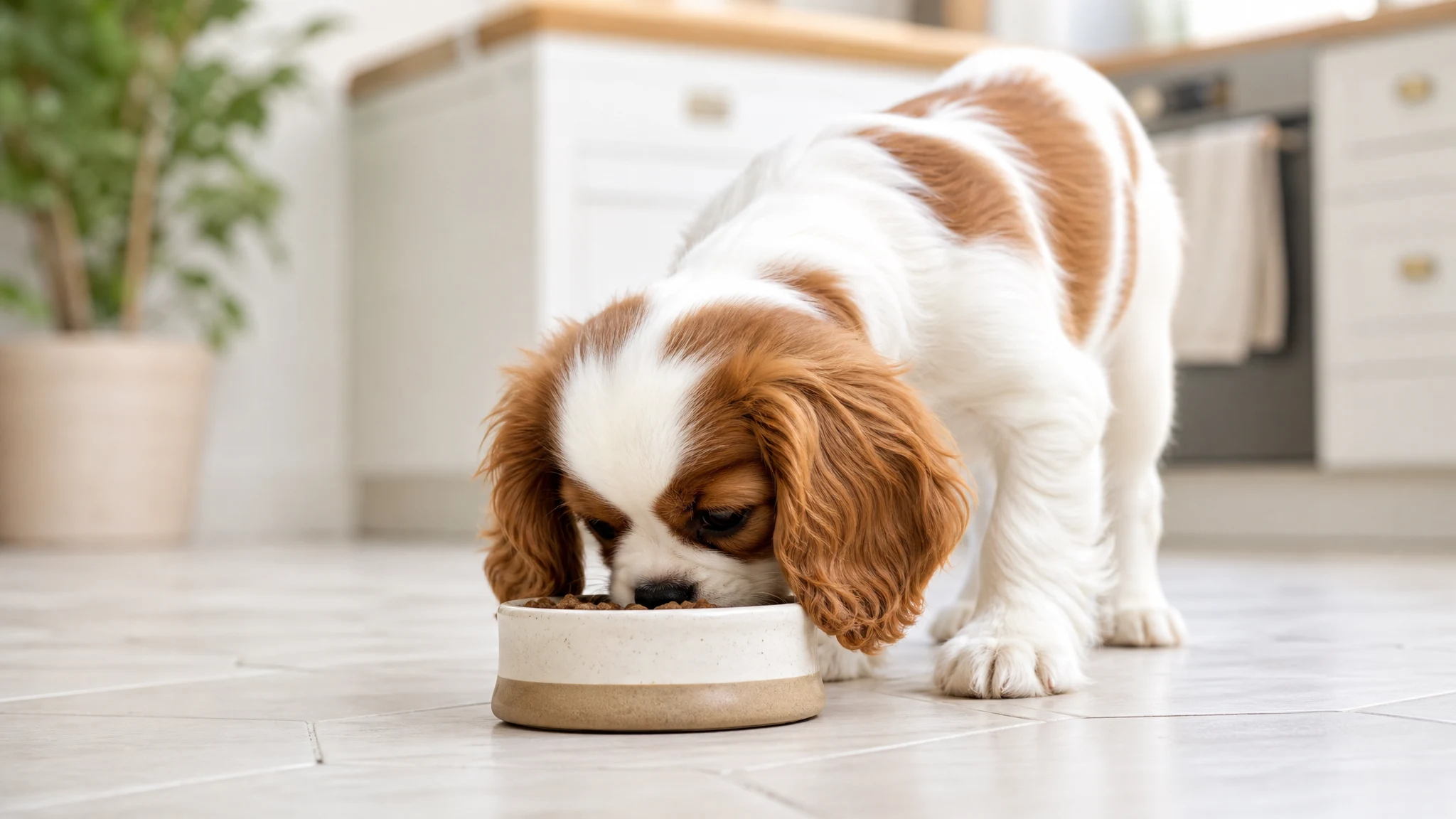
General nutrition information compiled from product labels and published sources, not veterinary advice. Your veterinarian is the right person to choose a diet for your dog, especially one with a health condition.
Choosing Cavalier King Charles Spaniel puppy food is mostly a label-reading exercise. The front of the bag is marketing. The back of the bag, with its nutritional adequacy statement, ingredient list and calorie count, is where the real comparison happens.
This guide covers what to check on a label, how a few puppy foods compare on paper, which red flags to watch for, and when to move to adult food. It is about product quality, not medical advice. Your veterinarian decides what is right for your individual puppy.
How we compared these foods
We compared label data published by each brand: the nutritional adequacy statement, the first five ingredients, the guaranteed analysis where one is given, calories, and the feeding guide notes. We did not run feeding trials, and we did not do taste tests. Nothing here is a ranking of how a food performs in a real dog.
Prices are not part of the comparison. Brands change prices often and they vary by store and bag size, so check the brand's own page or your usual store for current costs.
Why a Cavalier puppy is a small-dog puppy
The Westminster Kennel Club lists the Cavalier as a toy breed, with a maximum weight of 18 pounds and a maximum height of 13 inches. WebMD gives an adult range of 13 to 18 pounds. That is far below the 70 pound line that matters for large-breed puppy rules.
This means the large-breed puppy calcium concerns you may read about do not apply to a Cavalier. A Cavalier puppy can eat either a growth food that includes large-size dogs or one that says "except for growth of large size dogs." Whole Dog Journal explains this wording in its guide to nutritional adequacy statements.
Vetstreet adds a practical point about small dogs in general. They usually need more calories per pound of body weight, and they may do better on a calorie-dense food or on several small meals a day. That is general small-dog guidance, not a Cavalier-specific rule.
What to look for on the label
1. A growth statement from AAFCO
Start with the nutritional adequacy statement. For a puppy, it should say the food is formulated to meet the AAFCO Dog Food Nutrient Profiles for growth, or for all life stages. A statement that only mentions "maintenance" is written for adult dogs and does not cover a growing puppy.
Per Whole Dog Journal, growth and all-life-stages foods must also say whether they cover the growth of large-size dogs (70 pounds or more as an adult). For a Cavalier, either wording is fine.
Also note how the claim is backed. Some statements say the food was "formulated to meet" the profiles. Others say animal feeding tests using AAFCO procedures substantiate it. Both are legitimate routes, and the label tells you which one the brand used.
2. An ingredient list you can read
Ingredients are listed by weight before cooking, so the first five tell you the most. Look for named protein sources, such as chicken, beef or chicken meal, rather than vague terms. A named "by-product meal" is a defined ingredient, not a hidden one, and whether you want it is a personal call.
Do not treat any single ingredient as good or bad on its own. The whole recipe has to meet the nutrient profile, and the statement is what tells you that.
3. Calories per cup
Calorie density matters for a toy-breed puppy, because the stomach is small and the daily amount is only a few cups at most. Two foods can look similar in the bowl and differ noticeably in calories. Always compare calories per cup, not just the weight of the bag.
CavalierHealth.org, an advocacy site, describes the breed as predisposed to obesity, citing a 1986 UK study. Treat that as a reason to measure meals and watch body condition, and to ask your veterinarian what a healthy weight looks like for your puppy.
4. Protein and fat numbers, compared fairly
Guaranteed analysis lists minimum protein and fat and maximum fiber. These are as-fed numbers, so they are only comparable between foods with similar moisture. A dry food and a fresh or canned food cannot be compared directly on these figures.
Some brands, such as Hill's, publish an average nutrient table on a dry matter basis instead. That is a different measure again, so do not set those numbers beside another brand's as-fed minimums.
5. Kibble size and shape
A Cavalier puppy has a small mouth. Brands describe their kibble in general terms, and none of the pages we compared give dimensions. If a puppy struggles with a food, a different shape or a softer option may help. Ask the brand or your veterinarian if you are unsure.
Cavalier puppy food options compared
These four options have a growth or all-life-stages statement on the brand's own page. Each is described only by the label data the brand publishes.
| Food | Form | AAFCO statement | Calories | Protein / fat (as published) |
|---|---|---|---|---|
| Royal Canin Cavalier King Charles Puppy | Dry | Growth, including large-size dogs | 368 kcal ME per cup | 28% min / 16% min |
| VICTOR Hi-Pro Plus Small & Medium Breed Puppy | Dry | All life stages, except large-size growth | 383 kcal per cup | 30% min / 18% min |
| Hill's Science Diet Puppy Small & Mini Entree | Canned | Growth, plus gestation and lactation | 223 kcal per 5.8 oz can | 28.5% / 22.5% (dry matter average) |
| Freshpet Small Dog Bite Size Chicken Recipe | Fresh | All life stages, except large-size growth | 267 kcal per cup | 16% min / 12% min |
The protein and fat columns mix as-fed and dry matter figures, so read across a row, not down a column.
Top picks by type
The brands' pages do not give prices we can cite, so we group these by type of food, not by cost. Check each brand's page for current pricing in your area.
Breed-specific dry food: Royal Canin Cavalier King Charles Puppy
This is the only food in the comparison made for the breed. Royal Canin's page lists it for puppies from 8 weeks to 10 months. The statement covers growth, including growth of large-size dogs.
The first five ingredients are chicken by-product meal, brewers rice, corn, chicken fat and wheat gluten. The guaranteed analysis shows a minimum of 28 percent protein and 16 percent fat, with a maximum of 4 percent fiber. It provides 368 kcal ME per cup, calculated, as fed.
The feeding table runs by puppy age (2 to 9 months) and target adult weight of 11, 15 or 18 pounds. Royal Canin describes the kibble as designed to be easy for a Cavalier to pick up and chew, though it gives no size. The brand's page says to move to the adult formula after 10 months.
The ingredient list is not grain-free and includes by-product meal. If those matter to you, they are visible on the label, so you can decide. See the Royal Canin product page for the full details.
Small-breed dry food with higher calories: VICTOR Hi-Pro Plus Small & Medium Breed Puppy
VICTOR's statement is for all life stages, except for growth of large size dogs. That wording is fine for a Cavalier, which stays well under 70 pounds.
The first five ingredients are beef, chicken, beef meal, chicken meal and whole grain sorghum. The label guarantees a minimum of 30 percent protein and 18 percent fat, and a maximum of 5 percent fiber. At 383 kcal per cup, it is the most calorie-dense dry option in this comparison.
That density can suit a toy-breed puppy with a small appetite. It also means measuring matters. The page says that after age one you should feed to maintain good body condition, using the chart as a guide. The brand describes the kibble as appropriately sized for small and medium breeds but gives no dimensions. See the VICTOR product page.
Canned option: Hill's Science Diet Puppy Small & Mini Entree
This is a 5.8 ounce can for puppies up to one year. It is also labeled for pregnant or nursing dogs. Hill's states that animal feeding tests using AAFCO procedures substantiate complete and balanced nutrition for growing puppies.
The first five ingredients are water, beef, chicken, whole grain corn and cracked pearled barley. A can provides 223 kcal. The page gives no guaranteed analysis, only a dry matter average of 28.5 percent protein, 22.5 percent fat and 2.1 percent fiber.
One quirk to check: the web address for this product says chicken, while the page text describes a Beef & Barley Entree. Confirm the recipe name on the can you are buying. Wet food is also not directly comparable to dry on a per-cup basis, because the page measures by can. See the Hill's product page.
Fresh option: Freshpet Small Dog Bite Size Chicken Recipe
Freshpet's statement covers all life stages, except growth of large-size dogs. That includes puppy growth for a small breed. The first five ingredients are chicken, chicken liver, carrots, cranberries and eggs, and the recipe is grain-free.
The label lists a minimum of 16 percent protein and 12 percent fat, and a maximum of 1.5 percent fiber. Those are as-fed figures for a high-moisture food, so they do not compare directly with kibble. It provides 267 kcal per cup, calculated.
The feeding table is by weight, with amounts for one meal or split into two. This is not a puppy-specific recipe, and Freshpet's page does not give a feeding guide by puppy age. Ask your veterinarian how to portion it for a growing dog. See the Freshpet product page.
A note on grain-free foods: the FDA has an ongoing investigation into reports of dilated cardiomyopathy in dogs eating certain diets. Its page was last updated December 23, 2022, and the FDA said it would not post more updates until there is meaningful new scientific information. That is a reason to talk to your veterinarian about the diet you choose, not a verdict on any one food.
Feeding amounts and meal frequency
Every feeding chart on a package is a starting point. Puppies differ in activity and growth rate, and the charts say to adjust to keep a healthy weight.
Because small dogs can do better with several small meals, many owners split the daily amount across multiple feedings. Freshpet's table, for example, notes the amount can be one meal or split in two. Ask your veterinarian how many meals suit your puppy at each age.
Use a measuring cup, not a scoop or a guess. For a dog that tops out at 18 pounds, a few extra kibbles daily add up. Cavaliers are also described as prone to weight gain, so keep treats in mind when you plan the day's food.
When to switch to adult food
Vetstreet says small dogs can generally move to adult food at about 90 percent of their adult weight, typically around 9 to 12 months. That is general small-dog guidance, not Cavalier-specific, so confirm the timing with your veterinarian.
Royal Canin's page says its Cavalier puppy formula is for puppies up to 10 months, then the adult formula. Its Cavalier adult formula is listed for purebred Cavaliers 10 months and older.
Switch gradually. Hill's recommends a 7 day transition on its adult page, mixing the new food in with the old. If you change brands, use the same approach.
Red flags to avoid
- No adequacy statement. If the bag does not say it meets AAFCO profiles for growth or all life stages, it is not appropriate for a puppy.
- A maintenance-only statement. This covers adult dogs, not growth.
- Health promises on the front. A food cannot prevent, treat or cure a disease. Only a veterinarian prescribes a therapeutic diet.
- Vague ingredient names. Unnamed "meat" or "animal" sources make it hard to know what you are feeding.
- Calories left unstated. You cannot portion a toy-breed puppy without them.
- Large-breed puppy foods chosen by mistake. They are not needed for a Cavalier, and the label wording tells you which type you are holding.
- Marketing claims you cannot check. "Premium" and "natural" have no label meaning you can compare. Stick to the statement, ingredients and analysis.
Where to buy
Start at the brand's own product page, which lists the current formula, the adequacy statement and the feeding guide. Check that the recipe name and life stage match what you plan to buy.
From there, you can buy from a local pet store or your veterinarian's office, or from the retailer you already use. We do not link to any store. Whichever you choose, check the best-by date and the bag condition, and make sure the life stage on the bag is puppy or all life stages.
If you are switching foods, buy a small bag first. A puppy that refuses a food or has an upset stomach is better served by a small purchase than a large one.
Choosing the best food for your Cavalier puppy
There is no single best puppy food for Cavalier King Charles Spaniels. The right food has a growth statement, a recipe you are comfortable with, a calorie count that lets you portion carefully, and a form your puppy will eat.
Use the label to narrow your list, then bring it to your veterinarian. They can check your puppy's weight, growth and health history, and tell you when to move to adult food.
Sources
- Royal Canin, Cavalier King Charles Puppy
- VICTOR, Hi-Pro Plus Small & Medium Breed Puppy
- Hill's Science Diet, Puppy Small & Mini canned
- Hill's Science Diet, Adult Small & Mini dry (transition guidance)
- Freshpet, Small Dog Bite Size Chicken Recipe
- Westminster Kennel Club, Cavalier King Charles Spaniel breed page
- WebMD, Cavalier King Charles Spaniels
- CavalierHealth.org, diets page
- Vetstreet, transitioning from puppy to adult food
- Whole Dog Journal, nutritional adequacy statements
- FDA CVM, canine DCM investigation